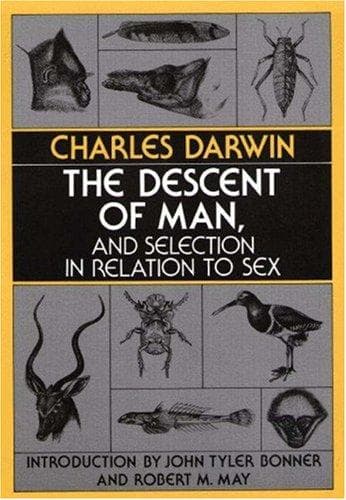
The Descent of Man, and Selection in Relation to SexDarwin, Charles
History
The Descent of Man, and Selection in Relation to Sex
Darwin, Charles
Evolution (Biology); Human beings -- Origin; Sex differences; Sexual dimorphism (Animals); Sexual selection in animals
the Old Testament.”) and not admit that almost all civilised nations
still retain traces of such rude habits as the forcible capture of
wives. What ancient nation, as the same author asks, can be named that
was originally monogamous? The primitive idea of justice, as shewn by
the law of battle and other customs of which vestiges still remain, was
likewise most rude. Many existing superstitions are the remnants of
former false religious beliefs. The highest form of religion—the grand
idea of God hating sin and loving righteousness—was unknown during
primeval times.
Turning to the other kind of evidence: Sir J. Lubbock has shewn that
some savages have recently improved a little in some of their simpler
arts. From the extremely curious account which he gives of the weapons,
tools, and arts, in use amongst savages in various parts of the world,
it cannot be doubted that these have nearly all been independent
discoveries, excepting perhaps the art of making fire. (36. Sir J.
Lubbock, ‘Prehistoric Times,’ 2nd edit. 1869, chaps. xv. and xvi. et
passim. See also the excellent 9th Chapter in Tylor’s ‘Early History of
Mankind,’ 2nd edit., 1870.) The Australian boomerang is a good instance
of one such independent discovery. The Tahitians when first visited had
advanced in many respects beyond the inhabitants of most of the other
Polynesian islands. There are no just grounds for the belief that the
high culture of the native Peruvians and Mexicans was derived from
abroad (37. Dr. F. Müller has made some good remarks to this effect in
the ‘Reise der Novara: Anthropolog. Theil,’ Abtheil. iii. 1868, s.
127.); many native plants were there cultivated, and a few native
animals domesticated. We should bear in mind that, judging from the
small influence of most missionaries, a wandering crew from some
semi-civilised land, if washed to the shores of America, would not have
produced any marked effect on the natives, unless they had already
become somewhat advanced. Looking to a very remote period in the
history of the world, we find, to use Sir J. Lubbock’s well-known
terms, a paleolithic and neolithic period; and no one will pretend that
the art of grinding rough flint tools was a borrowed one. In all parts
of Europe, as far east as Greece, in Palestine, India, Japan, New
Zealand, and Africa, including Egypt, flint tools have been discovered
in abundance; and of their use the existing inhabitants retain no
tradition. There is also indirect evidence of their former use by the
Chinese and ancient Jews. Hence there can hardly be a doubt that the
inhabitants of these countries, which include nearly the whole
civilised world, were once in a barbarous condition. To believe that
man was aboriginally civilised and then suffered utter degradation in
so many regions, is to take a pitiably low view of human nature. It is
apparently a truer and more cheerful view that progress has been much
more general than retrogression; that man has risen, though by slow and
Public-domain text, read in full here on John Shaqi.
Reviews
Reviews
No reviews yet
Be the first to share your thoughts on this work.
Elsewhere in the archive
Join the Discussion
Join the discussion
Sign in to leave a comment or review.
Sign InorCreate an account