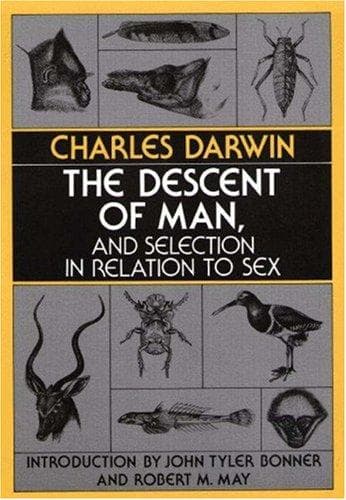
The Descent of Man, and Selection in Relation to SexDarwin, Charles
History
The Descent of Man, and Selection in Relation to Sex
Darwin, Charles
Evolution (Biology); Human beings -- Origin; Sex differences; Sexual dimorphism (Animals); Sexual selection in animals
classification; for they can hardly be due to adaptations within a late
period; and thus they reveal the old lines of descent or of true
affinity.
We can further see why a great amount of modification in some one
character ought not to lead us to separate widely any two organisms. A
part which already differs much from the same part in other allied
forms has already, according to the theory of evolution, varied much;
consequently it would (as long as the organism remained exposed to the
same exciting conditions) be liable to further variations of the same
kind; and these, if beneficial, would be preserved, and thus be
continually augmented. In many cases the continued development of a
part, for instance, of the beak of a bird, or of the teeth of a mammal,
would not aid the species in gaining its food, or for any other object;
but with man we can see no definite limit to the continued development
of the brain and mental faculties, as far as advantage is concerned.
Therefore in determining the position of man in the natural or
genealogical system, the extreme development of his brain ought not to
outweigh a multitude of resemblances in other less important or quite
unimportant points.
The greater number of naturalists who have taken into consideration the
whole structure of man, including his mental faculties, have followed
Blumenbach and Cuvier, and have placed man in a separate Order, under
the title of the Bimana, and therefore on an equality with the orders
of the Quadrumana, Carnivora, etc. Recently many of our best
naturalists have recurred to the view first propounded by Linnaeus, so
remarkable for his sagacity, and have placed man in the same Order with
the Quadrumana, under the title of the Primates. The justice of this
conclusion will be admitted: for in the first place, we must bear in
mind the comparative insignificance for classification of the great
development of the brain in man, and that the strongly-marked
differences between the skulls of man and the Quadrumana (lately
insisted upon by Bischoff, Aeby, and others) apparently follow from
their differently developed brains. In the second place, we must
remember that nearly all the other and more important differences
between man and the Quadrumana are manifestly adaptive in their nature,
and relate chiefly to the erect position of man; such as the structure
of his hand, foot, and pelvis, the curvature of his spine, and the
position of his head. The family of Seals offers a good illustration of
the small importance of adaptive characters for classification. These
animals differ from all other Carnivora in the form of their bodies and
in the structure of their limbs, far more than does man from the higher
apes; yet in most systems, from that of Cuvier to the most recent one
by Mr. Flower (4. ‘Proceedings Zoological Society,’ 1863, p. 4.), seals
are ranked as a mere family in the Order of the Carnivora. If man had
Public-domain text, read in full here on John Shaqi.
Reviews
Reviews
No reviews yet
Be the first to share your thoughts on this work.
Elsewhere in the archive
Join the Discussion
Join the discussion
Sign in to leave a comment or review.
Sign InorCreate an account