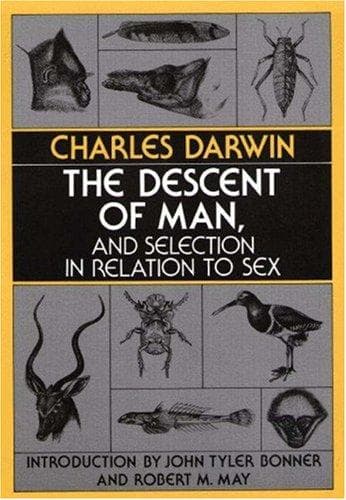
The Descent of Man, and Selection in Relation to SexDarwin, Charles
History
The Descent of Man, and Selection in Relation to Sex
Darwin, Charles
Evolution (Biology); Human beings -- Origin; Sex differences; Sexual dimorphism (Animals); Sexual selection in animals
difference is bridged over by other insects; and this is not the case
with man and the higher apes. But we have every reason to believe that
the breaks in the series are simply the results of many forms having
become extinct.
Professor Owen, relying chiefly on the structure of the brain, has
divided the mammalian series into four sub-classes. One of these he
devotes to man; in another he places both the marsupials and the
Monotremata; so that he makes man as distinct from all other mammals as
are these two latter groups conjoined. This view has not been accepted,
as far as I am aware, by any naturalist capable of forming an
independent judgment, and therefore need not here be further
considered.
We can understand why a classification founded on any single character
or organ—even an organ so wonderfully complex and important as the
brain—or on the high development of the mental faculties, is almost
sure to prove unsatisfactory. This principle has indeed been tried with
hymenopterous insects; but when thus classed by their habits or
instincts, the arrangement proved thoroughly artificial. (3. Westwood,
‘Modern Classification of Insects,’ vol. ii. 1840, p. 87.)
Classifications may, of course, be based on any character whatever, as
on size, colour, or the element inhabited; but naturalists have long
felt a profound conviction that there is a natural system. This system,
it is now generally admitted, must be, as far as possible, genealogical
in arrangement,—that is, the co-descendants of the same form must be
kept together in one group, apart from the co-descendants of any other
form; but if the parent-forms are related, so will be their
descendants, and the two groups together will form a larger group. The
amount of difference between the several groups—that is the amount of
modification which each has undergone—is expressed by such terms as
genera, families, orders, and classes. As we have no record of the
lines of descent, the pedigree can be discovered only by observing the
degrees of resemblance between the beings which are to be classed. For
this object numerous points of resemblance are of much more importance
than the amount of similarity or dissimilarity in a few points. If two
languages were found to resemble each other in a multitude of words and
points of construction, they would be universally recognised as having
sprung from a common source, notwithstanding that they differed greatly
in some few words or points of construction. But with organic beings
the points of resemblance must not consist of adaptations to similar
habits of life: two animals may, for instance, have had their whole
frames modified for living in the water, and yet they will not be
brought any nearer to each other in the natural system. Hence we can
see how it is that resemblances in several unimportant structures, in
useless and rudimentary organs, or not now functionally active, or in
an embryological condition, are by far the most serviceable for
Public-domain text, read in full here on John Shaqi.
Reviews
Reviews
No reviews yet
Be the first to share your thoughts on this work.
Elsewhere in the archive
Join the Discussion
Join the discussion
Sign in to leave a comment or review.
Sign InorCreate an account