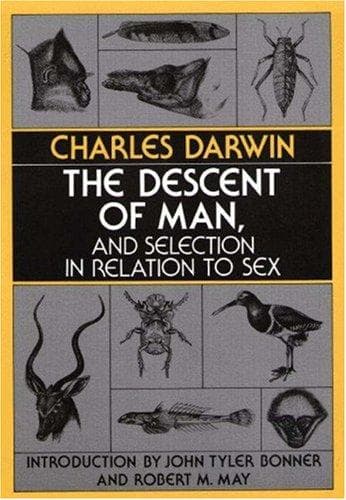
The Descent of Man, and Selection in Relation to SexDarwin, Charles
History
The Descent of Man, and Selection in Relation to Sex
Darwin, Charles
Evolution (Biology); Human beings -- Origin; Sex differences; Sexual dimorphism (Animals); Sexual selection in animals
The faces of many monkeys are ornamented with beards, whiskers, or
moustaches. The hair on the head grows to a great length in some
species of Semnopithecus (6. Isidore Geoffroy St.-Hilaire, ‘Hist. Nat.
Gen.’ tom. ii. 1859, p. 217.); and in the Bonnet monkey (Macacus
radiatus) it radiates from a point on the crown, with a parting down
the middle. It is commonly said that the forehead gives to man his
noble and intellectual appearance; but the thick hair on the head of
the Bonnet monkey terminates downwards abruptly, and is succeeded by
hair so short and fine that at a little distance the forehead, with the
exception of the eyebrows, appears quite naked. It has been erroneously
asserted that eyebrows are not present in any monkey. In the species
just named the degree of nakedness of the forehead differs in different
individuals; and Eschricht states (7. ‘Über die Richtung der Haare,’
etc., Müller’s ‘Archiv fur Anat. und Phys.’ 1837, s. 51.) that in our
children the limit between the hairy scalp and the naked forehead is
sometimes not well defined; so that here we seem to have a trifling
case of reversion to a progenitor, in whom the forehead had not as yet
become quite naked.
It is well known that the hair on our arms tends to converge from above
and below to a point at the elbow. This curious arrangement, so unlike
that in most of the lower mammals, is common to the gorilla,
chimpanzee, orang, some species of Hylobates, and even to some few
American monkeys. But in Hylobates agilis the hair on the fore-arm is
directed downwards or towards the wrist in the ordinary manner; and in
H. lar it is nearly erect, with only a very slight forward inclination;
so that in this latter species it is in a transitional state. It can
hardly be doubted that with most mammals the thickness of the hair on
the back and its direction, is adapted to throw off the rain; even the
transverse hairs on the fore-legs of a dog may serve for this end when
he is coiled up asleep. Mr. Wallace, who has carefully studied the
habits of the orang, remarks that the convergence of the hair towards
the elbow on the arms of the orang may be explained as serving to throw
off the rain, for this animal during rainy weather sits with its arms
bent, and with the hands clasped round a branch or over its head.
According to Livingstone, the gorilla also “sits in pelting rain with
his hands over his head.” (8. Quoted by Reade, ‘The African Sketch
Book,’ vol i. 1873, p. 152.) If the above explanation is correct, as
seems probable, the direction of the hair on our own arms offers a
curious record of our former state; for no one supposes that it is now
of any use in throwing off the rain; nor, in our present erect
condition, is it properly directed for this purpose.
Public-domain text, read in full here on John Shaqi.
Reviews
Reviews
No reviews yet
Be the first to share your thoughts on this work.
Elsewhere in the archive
Join the Discussion
Join the discussion
Sign in to leave a comment or review.
Sign InorCreate an account