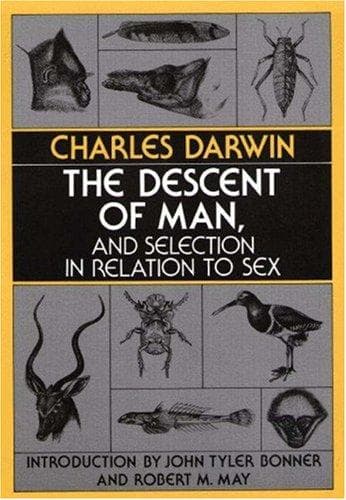
The Descent of Man, and Selection in Relation to SexDarwin, Charles
History
The Descent of Man, and Selection in Relation to Sex
Darwin, Charles
Evolution (Biology); Human beings -- Origin; Sex differences; Sexual dimorphism (Animals); Sexual selection in animals
It would, however, be rash to trust too much to the principle of
adaptation in regard to the direction of the hair in man or his early
progenitors; for it is impossible to study the figures given by
Eschricht of the arrangement of the hair on the human foetus (this
being the same as in the adult) and not agree with this excellent
observer that other and more complex causes have intervened. The points
of convergence seem to stand in some relation to those points in the
embryo which are last closed in during development. There appears,
also, to exist some relation between the arrangement of the hair on the
limbs, and the course of the medullary arteries. (9. On the hair in
Hylobates, see ‘Natural History of Mammals,’ by C.L. Martin, 1841, p.
415. Also, Isidore Geoffroy on the American monkeys and other kinds,
‘Hist. Nat. Gen.’ vol. ii. 1859, pp. 216, 243. Eschricht, ibid. s. 46,
55, 61. Owen, ‘Anatomy of Vertebrates,’ vol. iii. p. 619. Wallace,
‘Contributions to the Theory of Natural Selection,’ 1870, p. 344.)
It must not be supposed that the resemblances between man and certain
apes in the above and in many other points—such as in having a naked
forehead, long tresses on the head, etc.,—are all necessarily the
result of unbroken inheritance from a common progenitor, or of
subsequent reversion. Many of these resemblances are more probably due
to analogous variation, which follows, as I have elsewhere attempted to
shew (10. ‘Origin of Species,’ 5th edit. 1869, p.194. ‘The Variation of
Animals and Plants under Domestication,’ vol. ii. 1868, p. 348.), from
co-descended organisms having a similar constitution, and having been
acted on by like causes inducing similar modifications. With respect to
the similar direction of the hair on the fore-arms of man and certain
monkeys, as this character is common to almost all the anthropomorphous
apes, it may probably be attributed to inheritance; but this is not
certain, as some very distinct American monkeys are thus characterised.
Public-domain text, read in full here on John Shaqi.
Reviews
Reviews
No reviews yet
Be the first to share your thoughts on this work.
Elsewhere in the archive
Join the Discussion
Join the discussion
Sign in to leave a comment or review.
Sign InorCreate an account