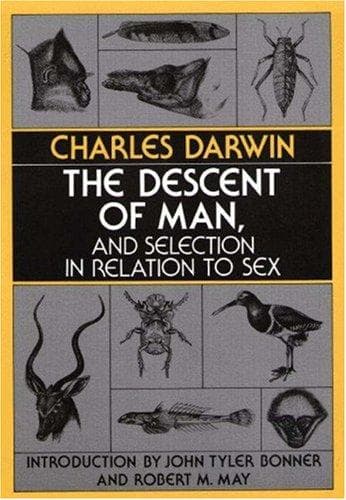
The Descent of Man, and Selection in Relation to SexDarwin, Charles
History
The Descent of Man, and Selection in Relation to Sex
Darwin, Charles
Evolution (Biology); Human beings -- Origin; Sex differences; Sexual dimorphism (Animals); Sexual selection in animals
Lastly, one single member of the immense and diversified class of
fishes, namely, the lancelet or amphioxus, is so different from all
other fishes, that Haeckel maintains that it ought to form a distinct
class in the vertebrate kingdom. This fish is remarkable for its
negative characters; it can hardly be said to possess a brain,
vertebral column, or heart, etc.; so that it was classed by the older
naturalists amongst the worms. Many years ago Prof. Goodsir perceived
that the lancelet presented some affinities with the Ascidians, which
are invertebrate, hermaphrodite, marine creatures permanently attached
to a support. They hardly appear like animals, and consist of a simple,
tough, leathery sack, with two small projecting orifices. They belong
to the Mulluscoida of Huxley—a lower division of the great kingdom of
the Mollusca; but they have recently been placed by some naturalists
amongst the Vermes or worms. Their larvae somewhat resemble tadpoles in
shape (23. At the Falkland Islands I had the satisfaction of seeing, in
April, 1833, and therefore some years before any other naturalist, the
locomotive larvae of a compound Ascidian, closely allied to Synoicum,
but apparently generically distinct from it. The tail was about five
times as long as the oblong head, and terminated in a very fine
filament. It was, as sketched by me under a simple microscope, plainly
divided by transverse opaque partitions, which I presume represent the
great cells figured by Kovalevsky. At an early stage of development the
tail was closely coiled round the head of the larva.), and have the
power of swimming freely about. Mr. Kovalevsky (24. ‘Memoires de
l’Acad. des Sciences de St. Petersbourg,’ tom. x. No. 15, 1866.) has
lately observed that the larvae of Ascidians are related to the
Vertebrata, in their manner of development, in the relative position of
the nervous system, and in possessing a structure closely like the
chorda dorsalis of vertebrate animals; and in this he has been since
confirmed by Prof. Kupffer. M. Kovalevsky writes to me from Naples,
that he has now carried these observations yet further, and should his
results be well established, the whole will form a discovery of the
very greatest value. Thus, if we may rely on embryology, ever the
safest guide in classification, it seems that we have at last gained a
clue to the source whence the Vertebrata were derived. (25. But I am
bound to add that some competent judges dispute this conclusion; for
instance, M. Giard, in a series of papers in the ‘Archives de Zoologie
Experimentale,’ for 1872. Nevertheless, this naturalist remarks, p.
281, “L’organisation de la larve ascidienne en dehors de toute
hypothèse et de toute théorie, nous montre comment la nature peut
produire la disposition fondamentale du type vertébré (l’existence
d’une corde dorsale) chez un invertébré par la seule condition vitale
de l’adaptation, et cette simple possibilité du passage supprime
Public-domain text, read in full here on John Shaqi.
Reviews
Reviews
No reviews yet
Be the first to share your thoughts on this work.
Elsewhere in the archive
Join the Discussion
Join the discussion
Sign in to leave a comment or review.
Sign InorCreate an account