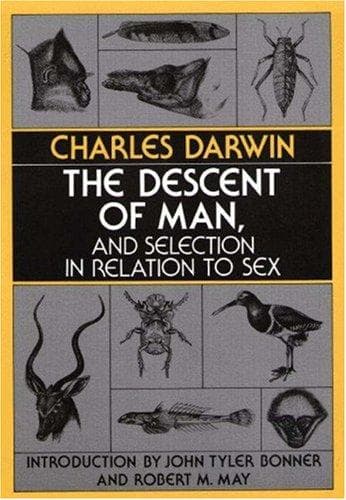
The Descent of Man, and Selection in Relation to SexDarwin, Charles
History
The Descent of Man, and Selection in Relation to Sex
Darwin, Charles
Evolution (Biology); Human beings -- Origin; Sex differences; Sexual dimorphism (Animals); Sexual selection in animals
l’abîme entre les deux sous-règnes, encore bien qu’en ignore par où le
passage s’est fait en realité.”) We should then be justified in
believing that at an extremely remote period a group of animals
existed, resembling in many respects the larvae of our present
Ascidians, which diverged into two great branches—the one retrograding
in development and producing the present class of Ascidians, the other
rising to the crown and summit of the animal kingdom by giving birth to
the Vertebrata.
We have thus far endeavoured rudely to trace the genealogy of the
Vertebrata by the aid of their mutual affinities. We will now look to
man as he exists; and we shall, I think, be able partially to restore
the structure of our early progenitors, during successive periods, but
not in due order of time. This can be effected by means of the
rudiments which man still retains, by the characters which occasionally
make their appearance in him through reversion, and by the aid of the
principles of morphology and embryology. The various facts, to which I
shall here allude, have been given in the previous chapters.
The early progenitors of man must have been once covered with hair,
both sexes having beards; their ears were probably pointed, and capable
of movement; and their bodies were provided with a tail, having the
proper muscles. Their limbs and bodies were also acted on by many
muscles which now only occasionally reappear, but are normally present
in the Quadrumana. At this or some earlier period, the great artery and
nerve of the humerus ran through a supra-condyloid foramen. The
intestine gave forth a much larger diverticulum or caecum than that now
existing. The foot was then prehensile, judging from the condition of
the great toe in the foetus; and our progenitors, no doubt, were
arboreal in their habits, and frequented some warm, forest-clad land.
The males had great canine teeth, which served them as formidable
weapons. At a much earlier period the uterus was double; the excreta
were voided through a cloaca; and the eye was protected by a third
eyelid or nictitating membrane. At a still earlier period the
progenitors of man must have been aquatic in their habits; for
morphology plainly tells us that our lungs consist of a modified
swim-bladder, which once served as a float. The clefts on the neck in
the embryo of man shew where the branchiae once existed. In the lunar
or weekly recurrent periods of some of our functions we apparently
still retain traces of our primordial birthplace, a shore washed by the
tides. At about this same early period the true kidneys were replaced
by the corpora wolffiana. The heart existed as a simple pulsating
vessel; and the chorda dorsalis took the place of a vertebral column.
These early ancestors of man, thus seen in the dim recesses of time,
must have been as simply, or even still more simply organised than the
lancelet or amphioxus.
Public-domain text, read in full here on John Shaqi.
Reviews
Reviews
No reviews yet
Be the first to share your thoughts on this work.
Elsewhere in the archive
Join the Discussion
Join the discussion
Sign in to leave a comment or review.
Sign InorCreate an account