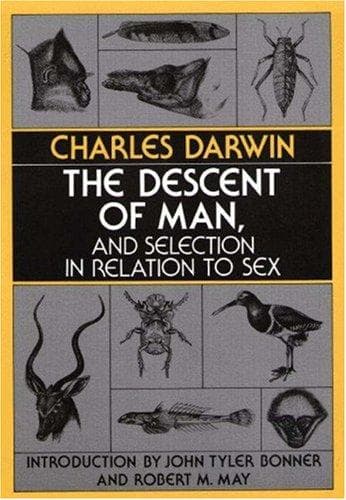
The Descent of Man, and Selection in Relation to SexDarwin, Charles
History
The Descent of Man, and Selection in Relation to Sex
Darwin, Charles
Evolution (Biology); Human beings -- Origin; Sex differences; Sexual dimorphism (Animals); Sexual selection in animals
It may be suggested, as another view, that long after the progenitors
of the whole mammalian class had ceased to be androgynous, both sexes
yielded milk, and thus nourished their young; and in the case of the
Marsupials, that both sexes carried their young in marsupial sacks.
This will not appear altogether improbable, if we reflect that the
males of existing syngnathous fishes receive the eggs of the females in
their abdominal pouches, hatch them, and afterwards, as some believe,
nourish the young (30. Mr. Lockwood believes (as quoted in ‘Quart.
Journal of Science,’ April 1868, p. 269), from what he has observed of
the development of Hippocampus, that the walls of the abdominal pouch
of the male in some way afford nourishment. On male fishes hatching the
ova in their mouths, see a very interesting paper by Prof. Wyman, in
‘Proc. Boston Soc. of Nat. Hist.’ Sept. 15, 1857; also Prof. Turner, in
‘Journal of Anatomy and Physiology,’ Nov. 1, 1866, p. 78. Dr. Gunther
has likewise described similar cases.);—that certain other male fishes
hatch the eggs within their mouths or branchial cavities;—that certain
male toads take the chaplets of eggs from the females, and wind them
round their own thighs, keeping them there until the tadpoles are
born;—that certain male birds undertake the whole duty of incubation,
and that male pigeons, as well as the females, feed their nestlings
with a secretion from their crops. But the above suggestion first
occurred to me from mammary glands of male mammals being so much more
perfectly developed than the rudiments of the other accessory
reproductive parts, which are found in the one sex though proper to the
other. The mammary glands and nipples, as they exist in male mammals,
can indeed hardly be called rudimentary; they are merely not fully
developed, and not functionally active. They are sympathetically
affected under the influence of certain diseases, like the same organs
in the female. They often secrete a few drops of milk at birth and at
puberty: this latter fact occurred in the curious case, before referred
to, where a young man possessed two pairs of mammae. In man and some
other male mammals these organs have been known occasionally to become
so well developed during maturity as to yield a fair supply of milk.
Now if we suppose that during a former prolonged period male mammals
aided the females in nursing their offspring (31. Mlle. C. Royer has
suggested a similar view in her ‘Origine de l’homme,’ etc., 1870.), and
that afterwards from some cause (as from the production of a smaller
number of young) the males ceased to give this aid, disuse of the
organs during maturity would lead to their becoming inactive; and from
two well-known principles of inheritance, this state of inactivity
would probably be transmitted to the males at the corresponding age of
maturity. But at an earlier age these organs would be left unaffected,
so that they would be almost equally well developed in the young of
both sexes.
Public-domain text, read in full here on John Shaqi.
Reviews
Reviews
No reviews yet
Be the first to share your thoughts on this work.
Elsewhere in the archive
Join the Discussion
Join the discussion
Sign in to leave a comment or review.
Sign InorCreate an account