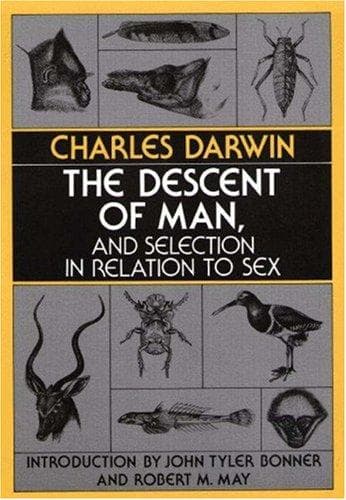
The Descent of Man, and Selection in Relation to SexDarwin, Charles
History
The Descent of Man, and Selection in Relation to Sex
Darwin, Charles
Evolution (Biology); Human beings -- Origin; Sex differences; Sexual dimorphism (Animals); Sexual selection in animals
—CONCLUSION—
Von Baer has defined advancement or progress in the organic scale
better than any one else, as resting on the amount of differentiation
and specialisation of the several parts of a being,—when arrived at
maturity, as I should be inclined to add. Now as organisms have become
slowly adapted to diversified lines of life by means of natural
selection, their parts will have become more and more differentiated
and specialised for various functions from the advantage gained by the
division of physiological labour. The same part appears often to have
been modified first for one purpose, and then long afterwards for some
other and quite distinct purpose; and thus all the parts are rendered
more and more complex. But each organism still retains the general type
of structure of the progenitor from which it was aboriginally derived.
In accordance with this view it seems, if we turn to geological
evidence, that organisation on the whole has advanced throughout the
world by slow and interrupted steps. In the great kingdom of the
Vertebrata it has culminated in man. It must not, however, be supposed
that groups of organic beings are always supplanted, and disappear as
soon as they have given birth to other and more perfect groups. The
latter, though victorious over their predecessors, may not have become
better adapted for all places in the economy of nature. Some old forms
appear to have survived from inhabiting protected sites, where they
have not been exposed to very severe competition; and these often aid
us in constructing our genealogies, by giving us a fair idea of former
and lost populations. But we must not fall into the error of looking at
the existing members of any lowly-organised group as perfect
representatives of their ancient predecessors.
Public-domain text, read in full here on John Shaqi.
Reviews
Reviews
No reviews yet
Be the first to share your thoughts on this work.
Elsewhere in the archive
Join the Discussion
Join the discussion
Sign in to leave a comment or review.
Sign InorCreate an account