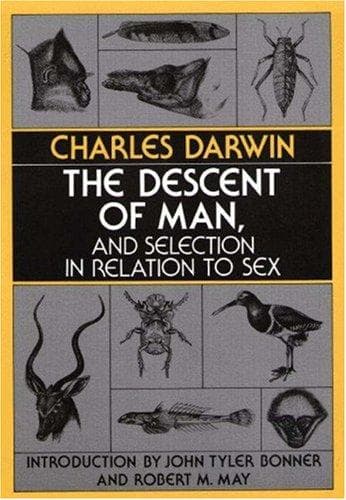
The Descent of Man, and Selection in Relation to SexDarwin, Charles
History
The Descent of Man, and Selection in Relation to Sex
Darwin, Charles
Evolution (Biology); Human beings -- Origin; Sex differences; Sexual dimorphism (Animals); Sexual selection in animals
Independently of fusion from intercrossing, the complete absence, in a
well-investigated region, of varieties linking together any two
closely-allied forms, is probably the most important of all the
criterions of their specific distinctness; and this is a somewhat
different consideration from mere constancy of character, for two forms
may be highly variable and yet not yield intermediate varieties.
Geographical distribution is often brought into play unconsciously and
sometimes consciously; so that forms living in two widely separated
areas, in which most of the other inhabitants are specifically
distinct, are themselves usually looked at as distinct; but in truth
this affords no aid in distinguishing geographical races from so-called
good or true species.
Now let us apply these generally-admitted principles to the races of
man, viewing him in the same spirit as a naturalist would any other
animal. In regard to the amount of difference between the races, we
must make some allowance for our nice powers of discrimination gained
by the long habit of observing ourselves. In India, as Elphinstone
remarks, although a newly-arrived European cannot at first distinguish
the various native races, yet they soon appear to him extremely
dissimilar (1. ‘History of India,’ 1841, vol. i. p. 323. Father Ripa
makes exactly the same remark with respect to the Chinese.); and the
Hindoo cannot at first perceive any difference between the several
European nations. Even the most distinct races of man are much more
like each other in form than would at first be supposed; certain negro
tribes must be excepted, whilst others, as Dr. Rohlfs writes to me, and
as I have myself seen, have Caucasian features. This general similarity
is well shewn by the French photographs in the Collection
Anthropologique du Museum de Paris of the men belonging to various
races, the greater number of which might pass for Europeans, as many
persons to whom I have shewn them have remarked. Nevertheless, these
men, if seen alive, would undoubtedly appear very distinct, so that we
are clearly much influenced in our judgment by the mere colour of the
skin and hair, by slight differences in the features, and by
expression.
Public-domain text, read in full here on John Shaqi.
Reviews
Reviews
No reviews yet
Be the first to share your thoughts on this work.
Elsewhere in the archive
Join the Discussion
Join the discussion
Sign in to leave a comment or review.
Sign InorCreate an account