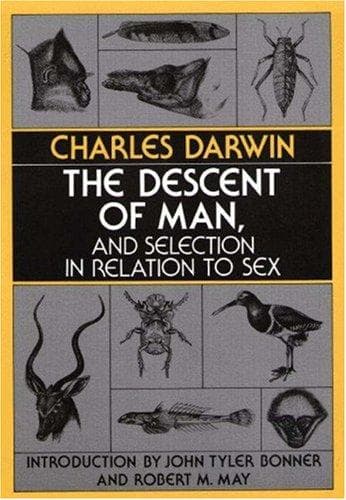
The Descent of Man, and Selection in Relation to SexDarwin, Charles
History
The Descent of Man, and Selection in Relation to Sex
Darwin, Charles
Evolution (Biology); Human beings -- Origin; Sex differences; Sexual dimorphism (Animals); Sexual selection in animals
the New World and Old World monkeys; and from the latter, at a remote
period, Man, the wonder and glory of the Universe, proceeded.
Thus we have given to man a pedigree of prodigious length, but not, it
may be said, of noble quality. The world, it has often been remarked,
appears as if it had long been preparing for the advent of man: and
this, in one sense is strictly true, for he owes his birth to a long
line of progenitors. If any single link in this chain had never
existed, man would not have been exactly what he now is. Unless we
wilfully close our eyes, we may, with our present knowledge,
approximately recognise our parentage; nor need we feel ashamed of it.
The most humble organism is something much higher than the inorganic
dust under our feet; and no one with an unbiassed mind can study any
living creature, however humble, without being struck with enthusiasm
at its marvellous structure and properties.
CHAPTER VII.
ON THE RACES OF MAN.
The nature and value of specific characters—Application to the races of
man—Arguments in favour of, and opposed to, ranking the so-called races
of man as distinct species—Sub-species—Monogenists and
polygenists—Convergence of character—Numerous points of resemblance in
body and mind between the most distinct races of man—The state of man
when he first spread over the earth—Each race not descended from a
single pair—The extinction of races—The formation of races—The effects
of crossing—Slight influence of the direct action of the conditions of
life—Slight or no influence of natural selection—Sexual selection.
It is not my intention here to describe the several so-called races of
men; but I am about to enquire what is the value of the differences
between them under a classificatory point of view, and how they have
originated. In determining whether two or more allied forms ought to be
ranked as species or varieties, naturalists are practically guided by
the following considerations; namely, the amount of difference between
them, and whether such differences relate to few or many points of
structure, and whether they are of physiological importance; but more
especially whether they are constant. Constancy of character is what is
chiefly valued and sought for by naturalists. Whenever it can be shewn,
or rendered probable, that the forms in question have remained distinct
for a long period, this becomes an argument of much weight in favour of
treating them as species. Even a slight degree of sterility between any
two forms when first crossed, or in their offspring, is generally
considered as a decisive test of their specific distinctness; and their
continued persistence without blending within the same area, is usually
accepted as sufficient evidence, either of some degree of mutual
sterility, or in the case of animals of some mutual repugnance to
pairing.
Public-domain text, read in full here on John Shaqi.
Reviews
Reviews
No reviews yet
Be the first to share your thoughts on this work.
Elsewhere in the archive
Join the Discussion
Join the discussion
Sign in to leave a comment or review.
Sign InorCreate an account