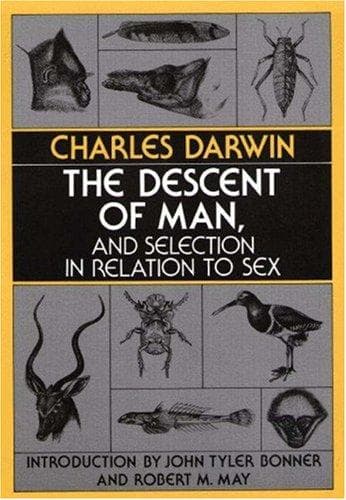
The Descent of Man, and Selection in Relation to SexDarwin, Charles
History
The Descent of Man, and Selection in Relation to Sex
Darwin, Charles
Evolution (Biology); Human beings -- Origin; Sex differences; Sexual dimorphism (Animals); Sexual selection in animals
We will first consider the arguments which may be advanced in favour of
classing the races of man as distinct species, and then the arguments
on the other side. If a naturalist, who had never before seen a Negro,
Hottentot, Australian, or Mongolian, were to compare them, he would at
once perceive that they differed in a multitude of characters, some of
slight and some of considerable importance. On enquiry he would find
that they were adapted to live under widely different climates, and
that they differed somewhat in bodily constitution and mental
disposition. If he were then told that hundreds of similar specimens
could be brought from the same countries, he would assuredly declare
that they were as good species as many to which he had been in the
habit of affixing specific names. This conclusion would be greatly
strengthened as soon as he had ascertained that these forms had all
retained the same character for many centuries; and that negroes,
apparently identical with existing negroes, had lived at least 4000
years ago. (5. With respect to the figures in the famous Egyptian caves
of Abou-Simbel, M. Pouchet says (‘The Plurality of the Human Races,’
Eng. translat., 1864, p. 50), that he was far from finding recognisable
representations of the dozen or more nations which some authors believe
that they can recognise. Even some of the most strongly-marked races
cannot be identified with that degree of unanimity which might have
been expected from what has been written on the subject. Thus Messrs.
Nott and Gliddon (‘Types of Mankind,’ p. 148), state that Rameses II.,
or the Great, has features superbly European; whereas Knox, another
firm believer in the specific distinctness of the races of man (‘Races
of Man,’ 1850, p. 201), speaking of young Memnon (the same as Rameses
II., as I am informed by Mr. Birch), insists in the strongest manner
that he is identical in character with the Jews of Antwerp. Again, when
I looked at the statue of Amunoph III., I agreed with two officers of
the establishment, both competent judges, that he had a strongly-marked
negro type of features; but Messrs. Nott and Gliddon (ibid. p. 146,
fig. 53), describe him as a hybrid, but not of “negro intermixture.”)
He would also hear, on the authority of an excellent observer, Dr. Lund
(6. As quoted by Nott and Gliddon, ‘Types of Mankind,’ 1854, p. 439.
They give also corroborative evidence; but C. Vogt thinks that the
subject requires further investigation.), that the human skulls found
in the caves of Brazil, entombed with many extinct mammals, belonged to
the same type as that now prevailing throughout the American Continent.
Public-domain text, read in full here on John Shaqi.
Reviews
Reviews
No reviews yet
Be the first to share your thoughts on this work.
Elsewhere in the archive
Join the Discussion
Join the discussion
Sign in to leave a comment or review.
Sign InorCreate an account