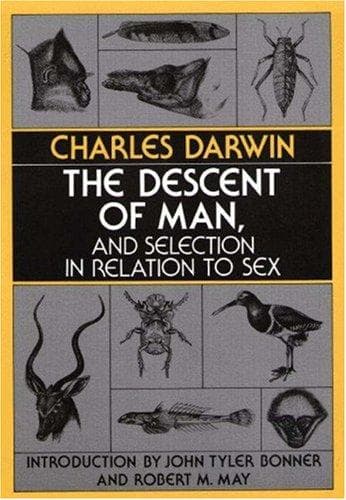
The Descent of Man, and Selection in Relation to SexDarwin, Charles
History
The Descent of Man, and Selection in Relation to Sex
Darwin, Charles
Evolution (Biology); Human beings -- Origin; Sex differences; Sexual dimorphism (Animals); Sexual selection in animals
Our naturalist would then perhaps turn to geographical distribution,
and he would probably declare that those forms must be distinct
species, which differ not only in appearance, but are fitted for hot,
as well as damp or dry countries, and for the Arctic regions. He might
appeal to the fact that no species in the group next to man—namely, the
Quadrumana, can resist a low temperature, or any considerable change of
climate; and that the species which come nearest to man have never been
reared to maturity, even under the temperate climate of Europe. He
would be deeply impressed with the fact, first noticed by Agassiz (7.
‘Diversity of Origin of the Human Races,’ in the ‘Christian Examiner,’
July 1850.), that the different races of man are distributed over the
world in the same zoological provinces, as those inhabited by
undoubtedly distinct species and genera of mammals. This is manifestly
the case with the Australian, Mongolian, and Negro races of man; in a
less well-marked manner with the Hottentots; but plainly with the
Papuans and Malays, who are separated, as Mr. Wallace has shewn, by
nearly the same line which divides the great Malayan and Australian
zoological provinces. The Aborigines of America range throughout the
Continent; and this at first appears opposed to the above rule, for
most of the productions of the Southern and Northern halves differ
widely: yet some few living forms, as the opossum, range from the one
into the other, as did formerly some of the gigantic Edentata. The
Esquimaux, like other Arctic animals, extend round the whole polar
regions. It should be observed that the amount of difference between
the mammals of the several zoological provinces does not correspond
with the degree of separation between the latter; so that it can hardly
be considered as an anomaly that the Negro differs more, and the
American much less from the other races of man, than do the mammals of
the African and American continents from the mammals of the other
provinces. Man, it may be added, does not appear to have aboriginally
inhabited any oceanic island; and in this respect, he resembles the
other members of his class.
Public-domain text, read in full here on John Shaqi.
Reviews
Reviews
No reviews yet
Be the first to share your thoughts on this work.
Elsewhere in the archive
Join the Discussion
Join the discussion
Sign in to leave a comment or review.
Sign InorCreate an account