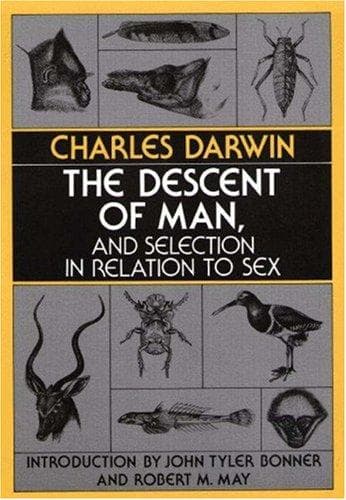
The Descent of Man, and Selection in Relation to SexDarwin, Charles
History
The Descent of Man, and Selection in Relation to Sex
Darwin, Charles
Evolution (Biology); Human beings -- Origin; Sex differences; Sexual dimorphism (Animals); Sexual selection in animals
‘Military and Anthropological Statistics of
American Soldiers,’ by B.A. Gould, 1869, p. 319.) as a well-known
phenomenon; and this, although a different consideration from their
lessened fertility, may perhaps be advanced as a proof of the specific
distinctness of the parent races. No doubt both animal and vegetable
hybrids, when produced from extremely distinct species, are liable to
premature death; but the parents of mulattoes cannot be put under the
category of extremely distinct species. The common Mule, so notorious
for long life and vigour, and yet so sterile, shews how little
necessary connection there is in hybrids between lessened fertility and
vitality; other analogous cases could be cited.
Even if it should hereafter be proved that all the races of men were
perfectly fertile together, he who was inclined from other reasons to
rank them as distinct species, might with justice argue that fertility
and sterility are not safe criterions of specific distinctness. We know
that these qualities are easily affected by changed conditions of life,
or by close inter-breeding, and that they are governed by highly
complex laws, for instance, that of the unequal fertility of converse
crosses between the same two species. With forms which must be ranked
as undoubted species, a perfect series exists from those which are
absolutely sterile when crossed, to those which are almost or
completely fertile. The degrees of sterility do not coincide strictly
with the degrees of difference between the parents in external
structure or habits of life. Man in many respects may be compared with
those animals which have long been domesticated, and a large body of
evidence can be advanced in favour of the Pallasian doctrine (14. The
‘Variation of Animals and Plants under Domestication,’ vol. ii. p. 109.
I may here remind the reader that the sterility of species when crossed
is not a specially-acquired quality, but, like the incapacity of
certain trees to be grafted together, is incidental on other acquired
differences. The nature of these differences is unknown, but they
relate more especially to the reproductive system, and much less so to
external structure or to ordinary differences in constitution. One
important element in the sterility of crossed species apparently lies
in one or both having been long habituated to fixed conditions; for we
know that changed conditions have a special influence on the
reproductive system, and we have good reason to believe (as before
remarked) that the fluctuating conditions of domestication tend to
eliminate that sterility which is so general with species, in a natural
state, when crossed. It has elsewhere been shewn by me (ibid. vol. ii.
p. 185, and ‘Origin of Species,’ 5th edit. p. 317), that the sterility
of crossed species has not been acquired through natural selection: we
can see that when two forms have already been rendered very sterile, it
is scarcely possible that their sterility should be augmented by the
Public-domain text, read in full here on John Shaqi.
Reviews
Reviews
No reviews yet
Be the first to share your thoughts on this work.
Elsewhere in the archive
Join the Discussion
Join the discussion
Sign in to leave a comment or review.
Sign InorCreate an account