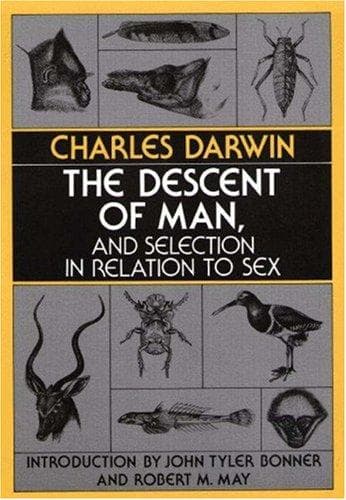
The Descent of Man, and Selection in Relation to SexDarwin, Charles
History
The Descent of Man, and Selection in Relation to Sex
Darwin, Charles
Evolution (Biology); Human beings -- Origin; Sex differences; Sexual dimorphism (Animals); Sexual selection in animals
preservation or survival of the more and more sterile individuals; for,
as the sterility increases, fewer and fewer offspring will be produced
from which to breed, and at last only single individuals will be
produced at the rarest intervals. But there is even a higher grade of
sterility than this. Both Gartner and Kolreuter have proved that in
genera of plants, including many species, a series can be formed from
species which, when crossed, yield fewer and fewer seeds, to species
which never produce a single seed, but yet are affected by the pollen
of the other species, as shewn by the swelling of the germen. It is
here manifestly impossible to select the more sterile individuals,
which have already ceased to yield seeds; so that the acme of
sterility, when the germen alone is affected, cannot have been gained
through selection. This acme, and no doubt the other grades of
sterility, are the incidental results of certain unknown differences in
the constitution of the reproductive system of the species which are
crossed.), that domestication tends to eliminate the sterility which is
so general a result of the crossing of species in a state of nature.
From these several considerations, it may be justly urged that the
perfect fertility of the intercrossed races of man, if established,
would not absolutely preclude us from ranking them as distinct species.
Independently of fertility, the characters presented by the offspring
from a cross have been thought to indicate whether or not the
parent-forms ought to be ranked as species or varieties; but after
carefully studying the evidence, I have come to the conclusion that no
general rules of this kind can be trusted. The ordinary result of a
cross is the production of a blended or intermediate form; but in
certain cases some of the offspring take closely after one parent-form,
and some after the other. This is especially apt to occur when the
parents differ in characters which first appeared as sudden variations
or monstrosities. (15. ‘The Variation of Animals,’ etc., vol. ii. p.
92.) I refer to this point, because Dr. Rohlfs informs me that he has
frequently seen in Africa the offspring of negroes crossed with members
of other races, either completely black or completely white, or rarely
piebald. On the other hand, it is notorious that in America mulattoes
commonly present an intermediate appearance.
Public-domain text, read in full here on John Shaqi.
Reviews
Reviews
No reviews yet
Be the first to share your thoughts on this work.
Elsewhere in the archive
Join the Discussion
Join the discussion
Sign in to leave a comment or review.
Sign InorCreate an account