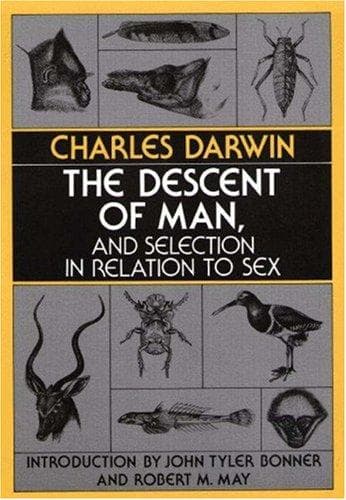
The Descent of Man, and Selection in Relation to SexDarwin, Charles
History
The Descent of Man, and Selection in Relation to Sex
Darwin, Charles
Evolution (Biology); Human beings -- Origin; Sex differences; Sexual dimorphism (Animals); Sexual selection in animals
Our naturalist would likewise be much disturbed as soon as he perceived
that the distinctive characters of all the races were highly variable.
This fact strikes every one on first beholding the negro slaves in
Brazil, who have been imported from all parts of Africa. The same
remark holds good with the Polynesians, and with many other races. It
may be doubted whether any character can be named which is distinctive
of a race and is constant. Savages, even within the limits of the same
tribe, are not nearly so uniform in character, as has been often
asserted. Hottentot women offer certain peculiarities, more strongly
marked than those occurring in any other race, but these are known not
to be of constant occurrence. In the several American tribes, colour
and hairiness differ considerably; as does colour to a certain degree,
and the shape of the features greatly, in the Negroes of Africa. The
shape of the skull varies much in some races (17. For instance, with
the aborigines of America and Australia, Prof. Huxley says (‘Transact.
Internat. Congress of Prehist. Arch.’ 1868, p. 105), that the skulls of
many South Germans and Swiss are “as short and as broad as those of the
Tartars,” etc.); and so it is with every other character. Now all
naturalists have learnt by dearly bought experience, how rash it is to
attempt to define species by the aid of inconstant characters.
But the most weighty of all the arguments against treating the races of
man as distinct species, is that they graduate into each other,
independently in many cases, as far as we can judge, of their having
intercrossed. Man has been studied more carefully than any other
animal, and yet there is the greatest possible diversity amongst
capable judges whether he should be classed as a single species or
race, or as two (Virey), as three (Jacquinot), as four (Kant), five
(Blumenbach), six (Buffon), seven (Hunter), eight (Agassiz), eleven
(Pickering), fifteen (Bory St. Vincent), sixteen (Desmoulins),
twenty-two (Morton), sixty (Crawfurd), or as sixty-three, according to
Burke. (18. See a good discussion on this subject in Waitz,
‘Introduction to Anthropology,’ Eng. translat., 1863, pp. 198-208, 227.
I have taken some of the above statements from H. Tuttle’s ‘Origin and
Antiquity of Physical Man,’ Boston, 1866, p. 35.) This diversity of
judgment does not prove that the races ought not to be ranked as
species, but it shews that they graduate into each other, and that it
is hardly possible to discover clear distinctive characters between
them.
Public-domain text, read in full here on John Shaqi.
Reviews
Reviews
No reviews yet
Be the first to share your thoughts on this work.
Elsewhere in the archive
Join the Discussion
Join the discussion
Sign in to leave a comment or review.
Sign InorCreate an account