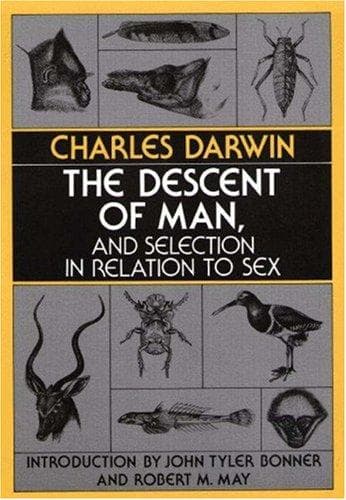
The Descent of Man, and Selection in Relation to SexDarwin, Charles
History
The Descent of Man, and Selection in Relation to Sex
Darwin, Charles
Evolution (Biology); Human beings -- Origin; Sex differences; Sexual dimorphism (Animals); Sexual selection in animals
Every naturalist who has had the misfortune to undertake the
description of a group of highly varying organisms, has encountered
cases (I speak after experience) precisely like that of man; and if of
a cautious disposition, he will end by uniting all the forms which
graduate into each other, under a single species; for he will say to
himself that he has no right to give names to objects which he cannot
define. Cases of this kind occur in the Order which includes man,
namely in certain genera of monkeys; whilst in other genera, as in
Cercopithecus, most of the species can be determined with certainty. In
the American genus Cebus, the various forms are ranked by some
naturalists as species, by others as mere geographical races. Now if
numerous specimens of Cebus were collected from all parts of South
America, and those forms which at present appear to be specifically
distinct, were found to graduate into each other by close steps, they
would usually be ranked as mere varieties or races; and this course has
been followed by most naturalists with respect to the races of man.
Nevertheless, it must be confessed that there are forms, at least in
the vegetable kingdom (19. Prof. Nageli has carefully described several
striking cases in his ‘Botanische Mittheilungen,’ B. ii. 1866, ss.
294-369. Prof. Asa Gray has made analogous remarks on some intermediate
forms in the Compositae of N. America.), which we cannot avoid naming
as species, but which are connected together by numberless gradations,
independently of intercrossing.
Some naturalists have lately employed the term “sub-species” to
designate forms which possess many of the characteristics of true
species, but which hardly deserve so high a rank. Now if we reflect on
the weighty arguments above given, for raising the races of man to the
dignity of species, and the insuperable difficulties on the other side
in defining them, it seems that the term “sub-species” might here be
used with propriety. But from long habit the term “race” will perhaps
always be employed. The choice of terms is only so far important in
that it is desirable to use, as far as possible, the same terms for the
same degrees of difference. Unfortunately this can rarely be done: for
the larger genera generally include closely-allied forms, which can be
distinguished only with much difficulty, whilst the smaller genera
within the same family include forms that are perfectly distinct; yet
all must be ranked equally as species. So again, species within the
same large genus by no means resemble each other to the same degree: on
the contrary, some of them can generally be arranged in little groups
round other species, like satellites round planets. (20. ‘Origin of
Species,’ 5th edit. p. 68.)
Public-domain text, read in full here on John Shaqi.
Reviews
Reviews
No reviews yet
Be the first to share your thoughts on this work.
Elsewhere in the archive
Join the Discussion
Join the discussion
Sign in to leave a comment or review.
Sign InorCreate an account