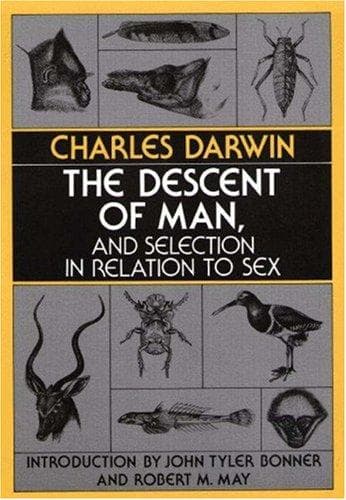
The Descent of Man, and Selection in Relation to SexDarwin, Charles
History
The Descent of Man, and Selection in Relation to Sex
Darwin, Charles
Evolution (Biology); Human beings -- Origin; Sex differences; Sexual dimorphism (Animals); Sexual selection in animals
such as the burying of the dead under megalithic structures. I remember
observing in South America (27. ‘Journal of Researches: Voyage of the
“Beagle,”’ p. 46.), that there, as in so many other parts of the world,
men have generally chosen the summits of lofty hills, to throw up piles
of stones, either as a record of some remarkable event, or for burying
their dead.
Now when naturalists observe a close agreement in numerous small
details of habits, tastes, and dispositions between two or more
domestic races, or between nearly-allied natural forms, they use this
fact as an argument that they are descended from a common progenitor
who was thus endowed; and consequently that all should be classed under
the same species. The same argument may be applied with much force to
the races of man.
As it is improbable that the numerous and unimportant points of
resemblance between the several races of man in bodily structure and
mental faculties (I do not here refer to similar customs) should all
have been independently acquired, they must have been inherited from
progenitors who had these same characters. We thus gain some insight
into the early state of man, before he had spread step by step over the
face of the earth. The spreading of man to regions widely separated by
the sea, no doubt, preceded any great amount of divergence of character
in the several races; for otherwise we should sometimes meet with the
same race in distinct continents; and this is never the case. Sir J.
Lubbock, after comparing the arts now practised by savages in all parts
of the world, specifies those which man could not have known, when he
first wandered from his original birthplace; for if once learnt they
would never have been forgotten. (28. ‘Prehistoric Times,’ 1869, p.
574.) He thus shews that “the spear, which is but a development of the
knife-point, and the club, which is but a long hammer, are the only
things left.” He admits, however, that the art of making fire probably
had been already discovered, for it is common to all the races now
existing, and was known to the ancient cave-inhabitants of Europe.
Perhaps the art of making rude canoes or rafts was likewise known; but
as man existed at a remote epoch, when the land in many places stood at
a very different level to what it does now, he would have been able,
without the aid of canoes, to have spread widely. Sir J. Lubbock
further remarks how improbable it is that our earliest ancestors could
have “counted as high as ten, considering that so many races now in
existence cannot get beyond four.” Nevertheless, at this early period,
the intellectual and social faculties of man could hardly have been
inferior in any extreme degree to those possessed at present by the
lowest savages; otherwise primeval man could not have been so eminently
successful in the struggle for life, as proved by his early and wide
diffusion.
Public-domain text, read in full here on John Shaqi.
Reviews
Reviews
No reviews yet
Be the first to share your thoughts on this work.
Elsewhere in the archive
Join the Discussion
Join the discussion
Sign in to leave a comment or review.
Sign InorCreate an account