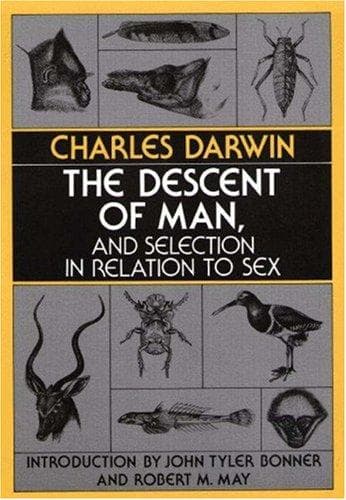
The Descent of Man, and Selection in Relation to SexDarwin, Charles
History
The Descent of Man, and Selection in Relation to Sex
Darwin, Charles
Evolution (Biology); Human beings -- Origin; Sex differences; Sexual dimorphism (Animals); Sexual selection in animals
From the fundamental differences between certain languages, some
philologists have inferred that when man first became widely diffused,
he was not a speaking animal; but it may be suspected that languages,
far less perfect than any now spoken, aided by gestures, might have
been used, and yet have left no traces on subsequent and more
highly-developed tongues. Without the use of some language, however
imperfect, it appears doubtful whether man’s intellect could have risen
to the standard implied by his dominant position at an early period.
Whether primeval man, when he possessed but few arts, and those of the
rudest kind, and when his power of language was extremely imperfect,
would have deserved to be called man, must depend on the definition
which we employ. In a series of forms graduating insensibly from some
ape-like creature to man as he now exists, it would be impossible to
fix on any definite point where the term “man” ought to be used. But
this is a matter of very little importance. So again, it is almost a
matter of indifference whether the so-called races of man are thus
designated, or are ranked as species or sub-species; but the latter
term appears the more appropriate. Finally, we may conclude that when
the principle of evolution is generally accepted, as it surely will be
before long, the dispute between the monogenists and the polygenists
will die a silent and unobserved death.
One other question ought not to be passed over without notice, namely,
whether, as is sometimes assumed, each sub-species or race of man has
sprung from a single pair of progenitors. With our domestic animals a
new race can readily be formed by carefully matching the varying
offspring from a single pair, or even from a single individual
possessing some new character; but most of our races have been formed,
not intentionally from a selected pair, but unconsciously by the
preservation of many individuals which have varied, however slightly,
in some useful or desired manner. If in one country stronger and
heavier horses, and in another country lighter and fleeter ones, were
habitually preferred, we may feel sure that two distinct sub-breeds
would be produced in the course of time, without any one pair having
been separated and bred from, in either country. Many races have been
thus formed, and their manner of formation is closely analogous to that
of natural species. We know, also, that the horses taken to the
Falkland Islands have, during successive generations, become smaller
and weaker, whilst those which have run wild on the Pampas have
acquired larger and coarser heads; and such changes are manifestly due,
not to any one pair, but to all the individuals having been subjected
to the same conditions, aided, perhaps, by the principle of reversion.
The new sub-breeds in such cases are not descended from any single
pair, but from many individuals which have varied in different degrees,
but in the same general manner; and we may conclude that the races of
Public-domain text, read in full here on John Shaqi.
Reviews
Reviews
No reviews yet
Be the first to share your thoughts on this work.
Elsewhere in the archive
Join the Discussion
Join the discussion
Sign in to leave a comment or review.
Sign InorCreate an account