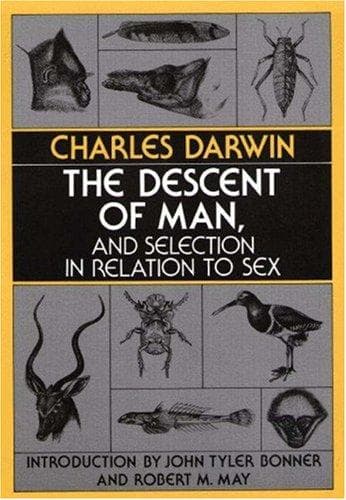
The Descent of Man, and Selection in Relation to SexDarwin, Charles
History
The Descent of Man, and Selection in Relation to Sex
Darwin, Charles
Evolution (Biology); Human beings -- Origin; Sex differences; Sexual dimorphism (Animals); Sexual selection in animals
With respect to the cause of this extraordinary state of things, Dr.
Story remarks that death followed the attempts to civilise the natives.
“If left to themselves to roam as they were wont and undisturbed, they
would have reared more children, and there would have been less
mortality.” Another careful observer of the natives, Mr. Davis,
remarks, “The births have been few and the deaths numerous. This may
have been in a great measure owing to their change of living and food;
but more so to their banishment from the mainland of Van Diemen’s Land,
and consequent depression of spirits” (Bonwick, pp. 388, 390).
Similar facts have been observed in two widely different parts of
Australia. The celebrated explorer, Mr. Gregory, told Mr. Bonwick, that
in Queensland “the want of reproduction was being already felt with the
blacks, even in the most recently settled parts, and that decay would
set in.” Of thirteen aborigines from Shark’s Bay who visited Murchison
River, twelve died of consumption within three months. (39. For these
cases, see Bonwick’s ‘Daily Life of the Tasmanians,’ 1870, p. 90: and
the ‘Last of the Tasmanians,’ 1870, p. 386.)
The decrease of the Maories of New Zealand has been carefully
investigated by Mr. Fenton, in an admirable Report, from which all the
following statements, with one exception, are taken. (40. ‘Observations
on the Aboriginal Inhabitants of New Zealand,’ published by the
Government, 1859.) The decrease in number since 1830 is admitted by
every one, including the natives themselves, and is still steadily
progressing. Although it has hitherto been found impossible to take an
actual census of the natives, their numbers were carefully estimated by
residents in many districts. The result seems trustworthy, and shows
that during the fourteen years, previous to 1858, the decrease was
19.42 per cent. Some of the tribes, thus carefully examined, lived
above a hundred miles apart, some on the coast, some inland; and their
means of subsistence and habits differed to a certain extent (p. 28).
The total number in 1858 was believed to be 53,700, and in 1872, after
a second interval of fourteen years, another census was taken, and the
number is given as only 36,359, shewing a decrease of 32.29 per cent!
(41. ‘New Zealand,’ by Alex. Kennedy, 1873, p. 47.) Mr. Fenton, after
shewing in detail the insufficiency of the various causes, usually
assigned in explanation of this extraordinary decrease, such as new
diseases, the profligacy of the women, drunkenness, wars, etc.,
concludes on weighty grounds that it depends chiefly on the
unproductiveness of the women, and on the extraordinary mortality of
the young children (pp. 31, 34). In proof of this he shews (p. 33) that
in 1844 there was one non-adult for every 2.57 adults; whereas in 1858
there was only one non-adult for every 3.27 adults. The mortality of
the adults is also great. He adduces as a further cause of the decrease
Public-domain text, read in full here on John Shaqi.
Reviews
Reviews
No reviews yet
Be the first to share your thoughts on this work.
Elsewhere in the archive
Join the Discussion
Join the discussion
Sign in to leave a comment or review.
Sign InorCreate an account