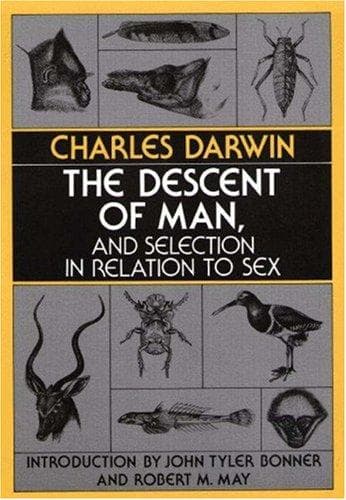
The Descent of Man, and Selection in Relation to SexDarwin, Charles
History
The Descent of Man, and Selection in Relation to Sex
Darwin, Charles
Evolution (Biology); Human beings -- Origin; Sex differences; Sexual dimorphism (Animals); Sexual selection in animals
the inequality of the sexes; for fewer females are born than males. To
this latter point, depending perhaps on a widely distinct cause, I
shall return in a future chapter. Mr. Fenton contrasts with
astonishment the decrease in New Zealand with the increase in Ireland;
countries not very dissimilar in climate, and where the inhabitants now
follow nearly similar habits. The Maories themselves (p. 35) “attribute
their decadence, in some measure, to the introduction of new food and
clothing, and the attendant change of habits”; and it will be seen,
when we consider the influence of changed conditions on fertility, that
they are probably right. The diminution began between the years 1830
and 1840; and Mr. Fenton shews (p. 40) that about 1830, the art of
manufacturing putrid corn (maize), by long steeping in water, was
discovered and largely practised; and this proves that a change of
habits was beginning amongst the natives, even when New Zealand was
only thinly inhabited by Europeans. When I visited the Bay of Islands
in 1835, the dress and food of the inhabitants had already been much
modified: they raised potatoes, maize, and other agricultural produce,
and exchanged them for English manufactured goods and tobacco.
It is evident from many statements in the life of Bishop Patteson (42.
‘Life of J.C. Patteson,’ by C.M. Younge, 1874; see more especially vol.
i. p. 530.), that the Melanesians of the New Hebrides and neighbouring
archipelagoes, suffered to an extraordinary degree in health, and
perished in large numbers, when they were removed to New Zealand,
Norfolk Island, and other salubrious places, in order to be educated as
missionaries.
The decrease of the native population of the Sandwich Islands is as
notorious as that of New Zealand. It has been roughly estimated by those
best capable of judging, that when Cook discovered the Islands in 1779, the
population amounted to about 300,000. According to a loose census in 1823,
the numbers then were 142,050. In 1832, and at several subsequent periods,
an accurate census was officially taken, but I have been able to obtain
only the following returns:
Native Population Annual rate of decrease
per cent., assuming it to
(Except during 1832 and have been uniform between
1836, when the few the successive censuses;
foreigners in the islands these censuses being taken
Year were included.) at irregular intervals.
1832 130,313
4.46
1836 108,579
2.47
1853 71,019
0.81
1860 67,084
2.18
1866 58,765
2.17
1872 51,531
Public-domain text, read in full here on John Shaqi.
Reviews
Reviews
No reviews yet
Be the first to share your thoughts on this work.
Elsewhere in the archive
Join the Discussion
Join the discussion
Sign in to leave a comment or review.
Sign InorCreate an account