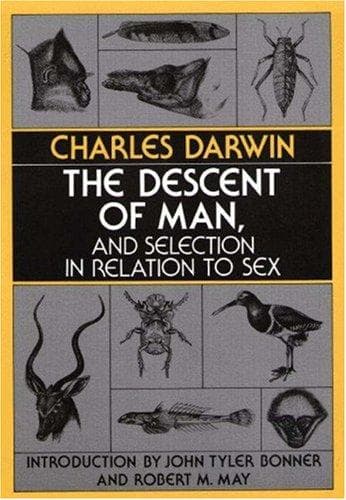
The Descent of Man, and Selection in Relation to SexDarwin, Charles
History
The Descent of Man, and Selection in Relation to Sex
Darwin, Charles
Evolution (Biology); Human beings -- Origin; Sex differences; Sexual dimorphism (Animals); Sexual selection in animals
In some cases the crossing of distinct races has led to the formation
of a new race. The singular fact that the Europeans and Hindoos, who
belong to the same Aryan stock, and speak a language fundamentally the
same, differ widely in appearance, whilst Europeans differ but little
from Jews, who belong to the Semitic stock, and speak quite another
language, has been accounted for by Broca (49. ‘On Anthropology,’
translation, ‘Anthropological Review,’ Jan. 1868, p. 38.), through
certain Aryan branches having been largely crossed by indigenous tribes
during their wide diffusion. When two races in close contact cross, the
first result is a heterogeneous mixture: thus Mr. Hunter, in describing
the Santali or hill-tribes of India, says that hundreds of
imperceptible gradations may be traced “from the black, squat tribes of
the mountains to the tall olive-coloured Brahman, with his intellectual
brow, calm eyes, and high but narrow head”; so that it is necessary in
courts of justice to ask the witnesses whether they are Santalis or
Hindoos. (50. ‘The Annals of Rural Bengal,’ 1868, p. 134.) Whether a
heterogeneous people, such as the inhabitants of some of the Polynesian
islands, formed by the crossing of two distinct races, with few or no
pure members left, would ever become homogeneous, is not known from
direct evidence. But as with our domesticated animals, a cross-breed
can certainly be fixed and made uniform by careful selection (51. ‘The
Variation of Animals and Plants under Domestication,’ vol. ii. p. 95.)
in the course of a few generations, we may infer that the free
intercrossing of a heterogeneous mixture during a long descent would
supply the place of selection, and overcome any tendency to reversion;
so that the crossed race would ultimately become homogeneous, though it
might not partake in an equal degree of the characters of the two
parent-races.
Public-domain text, read in full here on John Shaqi.
Reviews
Reviews
No reviews yet
Be the first to share your thoughts on this work.
Elsewhere in the archive
Join the Discussion
Join the discussion
Sign in to leave a comment or review.
Sign InorCreate an account