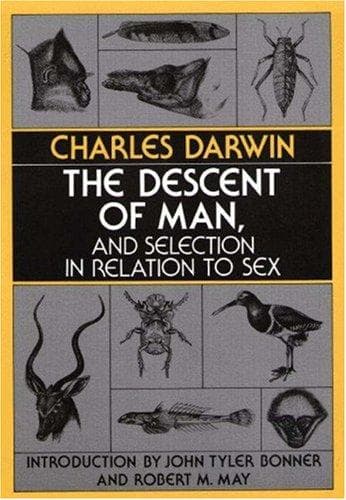
The Descent of Man, and Selection in Relation to SexDarwin, Charles
History
The Descent of Man, and Selection in Relation to Sex
Darwin, Charles
Evolution (Biology); Human beings -- Origin; Sex differences; Sexual dimorphism (Animals); Sexual selection in animals
Of all the differences between the races of man, the colour of the skin
is the most conspicuous and one of the best marked. It was formerly
thought that differences of this kind could be accounted for by long
exposure to different climates; but Pallas first shewed that this is
not tenable, and he has since been followed by almost all
anthropologists. (52. Pallas, ‘Act. Acad. St. Petersburg,’ 1780, part
ii. p. 69. He was followed by Rudolphi, in his ‘Beytrage zur
Anthropologie,’ 1812. An excellent summary of the evidence is given by
Godron, ‘De l’Espèce,’ 1859, vol. ii. p. 246, etc.) This view has been
rejected chiefly because the distribution of the variously coloured
races, most of whom must have long inhabited their present homes, does
not coincide with corresponding differences of climate. Some little
weight may be given to such cases as that of the Dutch families, who,
as we hear on excellent authority (53. Sir Andrew Smith, as quoted by
Knox, ‘Races of Man,’ 1850, p. 473.), have not undergone the least
change of colour after residing for three centuries in South Africa. An
argument on the same side may likewise be drawn from the uniform
appearance in various parts of the world of gipsies and Jews, though
the uniformity of the latter has been somewhat exaggerated. (54. See De
Quatrefages on this head, ‘Revue des Cours Scientifiques,’ Oct. 17,
1868, p. 731.) A very damp or a very dry atmosphere has been supposed
to be more influential in modifying the colour of the skin than mere
heat; but as D’Orbigny in South America, and Livingstone in Africa,
arrived at diametrically opposite conclusions with respect to dampness
and dryness, any conclusion on this head must be considered as very
doubtful. (55. Livingstone’s ‘Travels and Researches in S. Africa,’
1857, pp. 338, 339. D’Orbigny, as quoted by Godron, ‘De l’Espece,’ vol.
ii. p. 266.)
Various facts, which I have given elsewhere, prove that the colour of
the skin and hair is sometimes correlated in a surprising manner with a
complete immunity from the action of certain vegetable poisons, and
from the attacks of certain parasites. Hence it occurred to me, that
negroes and other dark races might have acquired their dark tints by
the darker individuals escaping from the deadly influence of the miasma
of their native countries, during a long series of generations.
Public-domain text, read in full here on John Shaqi.
Reviews
Reviews
No reviews yet
Be the first to share your thoughts on this work.
Elsewhere in the archive
Join the Discussion
Join the discussion
Sign in to leave a comment or review.
Sign InorCreate an account