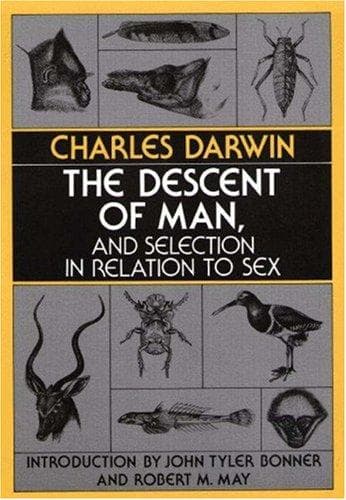
The Descent of Man, and Selection in Relation to SexDarwin, Charles
History
The Descent of Man, and Selection in Relation to Sex
Darwin, Charles
Evolution (Biology); Human beings -- Origin; Sex differences; Sexual dimorphism (Animals); Sexual selection in animals
I afterwards found that this same idea had long ago occurred to Dr.
Wells. (56. See a paper read before the Royal Soc. in 1813, and
published in his Essays in 1818. I have given an account of Dr. Wells’
views in the Historical Sketch (p. xvi.) to my ‘Origin of Species.’
Various cases of colour correlated with constitutional peculiarities
are given in my ‘Variation of Animals and Plants under Domestication,’
vol. ii. pp. 227, 335.) It has long been known that negroes, and even
mulattoes, are almost completely exempt from the yellow-fever, so
destructive in tropical America. (57. See, for instance, Nott and
Gliddon, ‘Types of Mankind,’ p. 68.) They likewise escape to a large
extent the fatal intermittent fevers, that prevail along at least 2600
miles of the shores of Africa, and which annually cause one-fifth of
the white settlers to die, and another fifth to return home invalided.
(58. Major Tulloch, in a paper read before the Statistical Society,
April 20, 1840, and given in the ‘Athenaeum,’ 1840, p. 353.) This
immunity in the negro seems to be partly inherent, depending on some
unknown peculiarity of constitution, and partly the result of
acclimatisation. Pouchet (59. ‘The Plurality of the Human Race’
(translat.), 1864, p. 60.) states that the negro regiments recruited
near the Soudan, and borrowed from the Viceroy of Egypt for the Mexican
war, escaped the yellow-fever almost equally with the negroes
originally brought from various parts of Africa and accustomed to the
climate of the West Indies. That acclimatisation plays a part, is shewn
by the many cases in which negroes have become somewhat liable to
tropical fevers, after having resided for some time in a colder
climate. (60. Quatrefages, ‘Unité de l’Espèce Humaine,’ 1861, p. 205.
Waitz, ‘Introduction to Anthropology,’ translat., vol. i. 1863, p. 124.
Livingstone gives analogous cases in his ‘Travels.’) The nature of the
climate under which the white races have long resided, likewise has
some influence on them; for during the fearful epidemic of yellow fever
in Demerara during 1837, Dr. Blair found that the death-rate of the
immigrants was proportional to the latitude of the country whence they
had come. With the negro the immunity, as far as it is the result of
acclimatisation, implies exposure during a prodigious length of time;
for the aborigines of tropical America who have resided there from time
immemorial, are not exempt from yellow fever; and the Rev. H.B.
Tristram states, that there are districts in Northern Africa which the
native inhabitants are compelled annually to leave, though the negroes
can remain with safety.
Public-domain text, read in full here on John Shaqi.
Reviews
Reviews
No reviews yet
Be the first to share your thoughts on this work.
Elsewhere in the archive
Join the Discussion
Join the discussion
Sign in to leave a comment or review.
Sign InorCreate an account