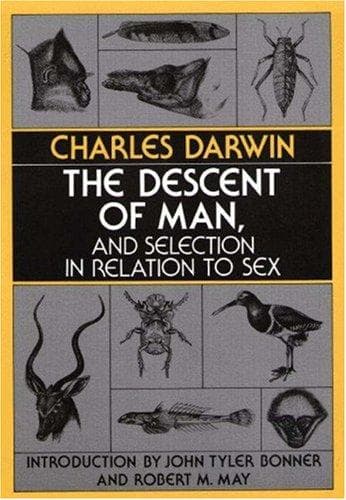
The Descent of Man, and Selection in Relation to SexDarwin, Charles
History
The Descent of Man, and Selection in Relation to Sex
Darwin, Charles
Evolution (Biology); Human beings -- Origin; Sex differences; Sexual dimorphism (Animals); Sexual selection in animals
altogether denies that Europeans with dark hair withstand a hot climate
better than other men: on the contrary, experience has taught him in
making a selection of men for service on the coast of Africa, to choose
those with red hair. (62. ‘Anthropological Review,’ Jan. 1866, p. xxi.
Dr. Sharpe also says, with respect to India (‘Man a Special Creation,’
1873, p. 118), “that it has been noticed by some medical officers that
Europeans with light hair and florid complexions suffer less from
diseases of tropical countries than persons with dark hair and sallow
complexions; and, so far as I know, there appear to be good grounds for
this remark.” On the other hand, Mr. Heddle, of Sierra Leone, “who has
had more clerks killed under him than any other man,” by the climate of
the West African Coast (W. Reade, ‘African Sketch Book,’ vol. ii. p.
522), holds a directly opposite view, as does Capt. Burton.) As far,
therefore, as these slight indications go, there seems no foundation
for the hypothesis, that blackness has resulted from the darker and
darker individuals having survived better during long exposure to
fever-generating miasma.
Dr. Sharpe remarks (63. ‘Man a Special Creation,’ 1873, p. 119.), that
a tropical sun, which burns and blisters a white skin, does not injure
a black one at all; and, as he adds, this is not due to habit in the
individual, for children only six or eight months old are often carried
about naked, and are not affected. I have been assured by a medical
man, that some years ago during each summer, but not during the winter,
his hands became marked with light brown patches, like, although larger
than freckles, and that these patches were never affected by
sun-burning, whilst the white parts of his skin have on several
occasions been much inflamed and blistered. With the lower animals
there is, also, a constitutional difference in liability to the action
of the sun between those parts of the skin clothed with white hair and
other parts. (64. ‘Variation of Animals and Plants under
Domestication,’ vol. ii. pp. 336, 337.) Whether the saving of the skin
from being thus burnt is of sufficient importance to account for a dark
tint having been gradually acquired by man through natural selection, I
am unable to judge. If it be so, we should have to assume that the
natives of tropical America have lived there for a much shorter time
than the Negroes in Africa, or the Papuans in the southern parts of the
Malay archipelago, just as the lighter-coloured Hindoos have resided in
India for a shorter time than the darker aborigines of the central and
southern parts of the peninsula.
Public-domain text, read in full here on John Shaqi.
Reviews
Reviews
No reviews yet
Be the first to share your thoughts on this work.
Elsewhere in the archive
Join the Discussion
Join the discussion
Sign in to leave a comment or review.
Sign InorCreate an account