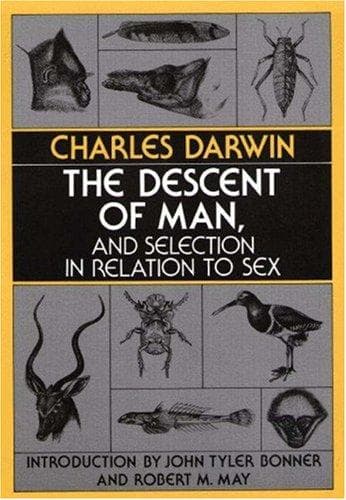
The Descent of Man, and Selection in Relation to SexDarwin, Charles
History
The Descent of Man, and Selection in Relation to Sex
Darwin, Charles
Evolution (Biology); Human beings -- Origin; Sex differences; Sexual dimorphism (Animals); Sexual selection in animals
Although with our present knowledge we cannot account for the
differences of colour in the races of man, through any advantage thus
gained, or from the direct action of climate; yet we must not quite
ignore the latter agency, for there is good reason to believe that some
inherited effect is thus produced. (65. See, for instance, Quatrefages
(‘Revue des Cours Scientifiques,’ Oct. 10, 1868, p. 724) on the effects
of residence in Abyssinia and Arabia, and other analogous cases. Dr.
Rolle (‘Der Mensch, seine Abstammung,’ etc., 1865, s. 99) states, on
the authority of Khanikof, that the greater number of German families
settled in Georgia, have acquired in the course of two generations dark
hair and eyes. Mr. D. Forbes informs me that the Quichuas in the Andes
vary greatly in colour, according to the position of the valleys
inhabited by them.)
We have seen in the second chapter that the conditions of life affect
the development of the bodily frame in a direct manner, and that the
effects are transmitted. Thus, as is generally admitted, the European
settlers in the United States undergo a slight but extraordinary rapid
change of appearance. Their bodies and limbs become elongated; and I
hear from Col. Bernys that during the late war in the United States,
good evidence was afforded of this fact by the ridiculous appearance
presented by the German regiments, when dressed in ready-made clothes
manufactured for the American market, and which were much too long for
the men in every way. There is, also, a considerable body of evidence
shewing that in the Southern States the house-slaves of the third
generation present a markedly different appearance from the
field-slaves. (66. Harlan, ‘Medical Researches,’ p. 532. Quatrefages
(‘Unité de l’Espèce Humaine,’ 1861, p. 128) has collected much evidence
on this head.)
If, however, we look to the races of man as distributed over the world,
we must infer that their characteristic differences cannot be accounted
for by the direct action of different conditions of life, even after
exposure to them for an enormous period of time. The Esquimaux live
exclusively on animal food; they are clothed in thick fur, and are
exposed to intense cold and to prolonged darkness; yet they do not
differ in any extreme degree from the inhabitants of Southern China,
who live entirely on vegetable food, and are exposed almost naked to a
hot, glaring climate. The unclothed Fuegians live on the marine
productions of their inhospitable shores; the Botocudos of Brazil
wander about the hot forests of the interior and live chiefly on
vegetable productions; yet these tribes resemble each other so closely
that the Fuegians on board the “Beagle” were mistaken by some
Brazilians for Botocudos. The Botocudos again, as well as the other
inhabitants of tropical America, are wholly different from the Negroes
who inhabit the opposite shores of the Atlantic, are exposed to a
nearly similar climate, and follow nearly the same habits of life.
Public-domain text, read in full here on John Shaqi.
Reviews
Reviews
No reviews yet
Be the first to share your thoughts on this work.
Elsewhere in the archive
Join the Discussion
Join the discussion
Sign in to leave a comment or review.
Sign InorCreate an account