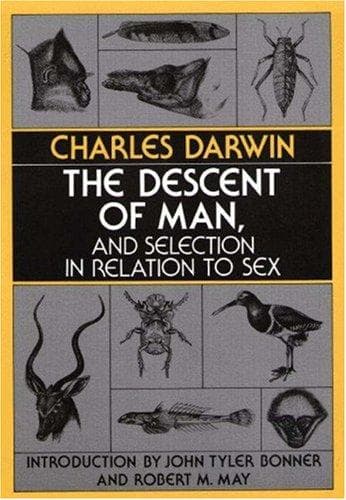
The Descent of Man, and Selection in Relation to SexDarwin, Charles
History
The Descent of Man, and Selection in Relation to Sex
Darwin, Charles
Evolution (Biology); Human beings -- Origin; Sex differences; Sexual dimorphism (Animals); Sexual selection in animals
We have now seen that the external characteristic differences between
the races of man cannot be accounted for in a satisfactory manner by
the direct action of the conditions of life, nor by the effects of the
continued use of parts, nor through the principle of correlation. We
are therefore led to enquire whether slight individual differences, to
which man is eminently liable, may not have been preserved and
augmented during a long series of generations through natural
selection. But here we are at once met by the objection that beneficial
variations alone can be thus preserved; and as far as we are enabled to
judge, although always liable to err on this head, none of the
differences between the races of man are of any direct or special
service to him. The intellectual and moral or social faculties must of
course be excepted from this remark. The great variability of all the
external differences between the races of man, likewise indicates that
they cannot be of much importance; for if important, they would long
ago have been either fixed and preserved, or eliminated. In this
respect man resembles those forms, called by naturalists protean or
polymorphic, which have remained extremely variable, owing, as it
seems, to such variations being of an indifferent nature, and to their
having thus escaped the action of natural selection.
We have thus far been baffled in all our attempts to account for the
differences between the races of man; but there remains one important
agency, namely Sexual Selection, which appears to have acted powerfully
on man, as on many other animals. I do not intend to assert that sexual
selection will account for all the differences between the races. An
unexplained residuum is left, about which we can only say, in our
ignorance, that as individuals are continually born with, for instance,
heads a little rounder or narrower, and with noses a little longer or
shorter, such slight differences might become fixed and uniform, if the
unknown agencies which induced them were to act in a more constant
manner, aided by long-continued intercrossing. Such variations come
under the provisional class, alluded to in our second chapter, which
for want of a better term are often called spontaneous. Nor do I
pretend that the effects of sexual selection can be indicated with
scientific precision; but it can be shewn that it would be an
inexplicable fact if man had not been modified by this agency, which
appears to have acted powerfully on innumerable animals. It can further
be shewn that the differences between the races of man, as in colour,
hairiness, form of features, etc., are of a kind which might have been
expected to come under the influence of sexual selection. But in order
to treat this subject properly, I have found it necessary to pass the
whole animal kingdom in review. I have therefore devoted to it the
Second Part of this work. At the close I shall return to man, and,
Public-domain text, read in full here on John Shaqi.
Reviews
Reviews
No reviews yet
Be the first to share your thoughts on this work.
Elsewhere in the archive
Join the Discussion
Join the discussion
Sign in to leave a comment or review.
Sign InorCreate an account