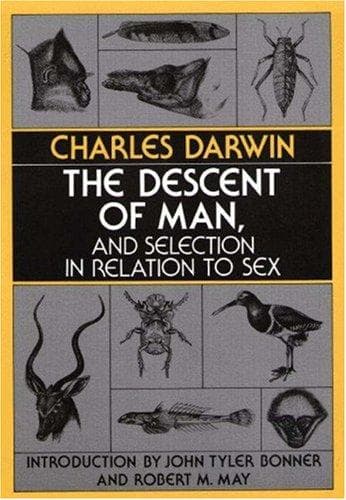
The Descent of Man, and Selection in Relation to SexDarwin, Charles
History
The Descent of Man, and Selection in Relation to Sex
Darwin, Charles
Evolution (Biology); Human beings -- Origin; Sex differences; Sexual dimorphism (Animals); Sexual selection in animals
after attempting to shew how far he has been modified through sexual
selection, will give a brief summary of the chapters in this First
Part.
NOTE ON THE RESEMBLANCES AND DIFFERENCES IN THE STRUCTURE AND THE
DEVELOPMENT OF THE BRAIN IN MAN AND APES BY PROFESSOR HUXLEY, F.R.S.
The controversy respecting the nature and the extent of the differences
in the structure of the brain in man and the apes, which arose some
fifteen years ago, has not yet come to an end, though the subject
matter of the dispute is, at present, totally different from what it
was formerly. It was originally asserted and re-asserted, with singular
pertinacity, that the brain of all the apes, even the highest, differs
from that of man, in the absence of such conspicuous structures as the
posterior lobes of the cerebral hemispheres, with the posterior cornu
of the lateral ventricle and the hippocampus minor, contained in those
lobes, which are so obvious in man.
But the truth that the three structures in question are as well
developed in apes’ as in human brains, or even better; and that it is
characteristic of all the Primates (if we exclude the Lemurs) to have
these parts well developed, stands at present on as secure a basis as
any proposition in comparative anatomy. Moreover, it is admitted by
every one of the long series of anatomists who, of late years, have
paid special attention to the arrangement of the complicated sulci and
gyri which appear upon the surface of the cerebral hemispheres in man
and the higher apes, that they are disposed after the very same pattern
in him, as in them. Every principal gyrus and sulcus of a chimpanzee’s
brain is clearly represented in that of a man, so that the terminology
which applies to the one answers for the other. On this point there is
no difference of opinion. Some years since, Professor Bischoff
published a memoir (70. ‘Die Grosshirn-Windungen des Menschen;’
‘Abhandlungen der K. Bayerischen Akademie,’ B. x. 1868.) on the
cerebral convolutions of man and apes; and as the purpose of my learned
colleague was certainly not to diminish the value of the differences
between apes and men in this respect, I am glad to make a citation from
him.
“That the apes, and especially the orang, chimpanzee and gorilla, come
very close to man in their organisation, much nearer than to any other
animal, is a well known fact, disputed by nobody. Looking at the matter
from the point of view of organisation alone, no one probably would
ever have disputed the view of Linnaeus, that man should be placed,
merely as a peculiar species, at the head of the mammalia and of those
apes. Both shew, in all their organs, so close an affinity, that the
most exact anatomical investigation is needed in order to demonstrate
those differences which really exist. So it is with the brains. The
brains of man, the orang, the chimpanzee, the gorilla, in spite of all
the important differences which they present, come very close to one
another” (loc. cit. p. 101).
Public-domain text, read in full here on John Shaqi.
Reviews
Reviews
No reviews yet
Be the first to share your thoughts on this work.
Elsewhere in the archive
Join the Discussion
Join the discussion
Sign in to leave a comment or review.
Sign InorCreate an account