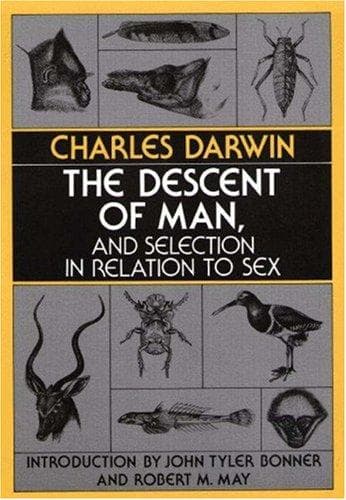
The Descent of Man, and Selection in Relation to SexDarwin, Charles
History
The Descent of Man, and Selection in Relation to Sex
Darwin, Charles
Evolution (Biology); Human beings -- Origin; Sex differences; Sexual dimorphism (Animals); Sexual selection in animals
3. At the latter part of this period, another sulcus, the
“posterio-parietal,” or “Fissure of Rolando” is developed, and it is
followed, in the course of the sixth month, by the other principal
sulci of the frontal, parietal, temporal and occipital lobes. There is,
however, no clear evidence that one of these constantly appears before
the other; and it is remarkable that, in the brain at the period
described and figured by Ecker (loc. cit. pp. 212-213, Taf. II, figs.
1, 2, 3, 4), the antero-temporal sulcus (scissure parallele) so
characteristic of the ape’s brain, is as well, if not better developed
than the fissure of Rolando, and is much more marked than the proper
frontal sulci.
Taking the facts as they now stand, it appears to me that the order of
the appearance of the sulci and gyri in the foetal human brain is in
perfect harmony with the general doctrine of evolution, and with the
view that man has been evolved from some ape-like form; though there
can be no doubt that form was, in many respects, different from any
member of the Primates now living.
Von Baer taught us, half a century ago, that, in the course of their
development, allied animals put on at first, the characters of the
greater groups to which they belong, and, by degrees, assume those
which restrict them within the limits of their family, genus, and
species; and he proved, at the same time, that no developmental stage
of a higher animal is precisely similar to the adult condition of any
lower animal. It is quite correct to say that a frog passes through the
condition of a fish, inasmuch as at one period of its life the tadpole
has all the characters of a fish, and if it went no further, would have
to be grouped among fishes. But it is equally true that a tadpole is
very different from any known fish.
In like manner, the brain of a human foetus, at the fifth month, may
correctly be said to be, not only the brain of an ape, but that of an
Arctopithecine or marmoset-like ape; for its hemispheres, with their
great posterior lobster, and with no sulci but the sylvian and the
calcarine, present the characteristics found only in the group of the
Arctopithecine Primates. But it is equally true, as Gratiolet remarks,
that, in its widely open sylvian fissure, it differs from the brain of
any actual marmoset. No doubt it would be much more similar to the
brain of an advanced foetus of a marmoset. But we know nothing whatever
of the development of the brain in the marmosets. In the Platyrrhini
proper, the only observation with which I am acquainted is due to
Pansch, who found in the brain of a foetal Cebus Apella, in addition to
the sylvian fissure and the deep calcarine fissure, only a very shallow
antero-temporal fissure (scissure parallele of Gratiolet).
Public-domain text, read in full here on John Shaqi.
Reviews
Reviews
No reviews yet
Be the first to share your thoughts on this work.
Elsewhere in the archive
Join the Discussion
Join the discussion
Sign in to leave a comment or review.
Sign InorCreate an account