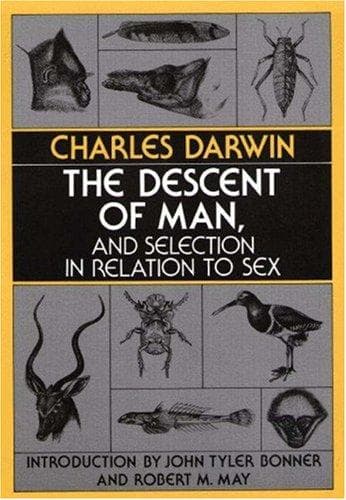
The Descent of Man, and Selection in Relation to SexDarwin, Charles
History
The Descent of Man, and Selection in Relation to Sex
Darwin, Charles
Evolution (Biology); Human beings -- Origin; Sex differences; Sexual dimorphism (Animals); Sexual selection in animals
Now this fact, taken together with the circumstance that the
antero-temporal sulcus is present in such Platyrrhini as the Saimiri,
which present mere traces of sulci on the anterior half of the exterior
of the cerebral hemispheres, or none at all, undoubtedly, so far as it
goes, affords fair evidence in favour of Gratiolet’s hypothesis, that
the posterior sulci appear before the anterior, in the brains of the
Platyrrhini. But, it by no means follows, that the rule which may hold
good for the Platyrrhini extends to the Catarrhini. We have no
information whatever respecting the development of the brain in the
Cynomorpha; and, as regards the Anthropomorpha, nothing but the account
of the brain of the Gibbon, near birth, already referred to. At the
present moment there is not a shadow of evidence to shew that the sulci
of a chimpanzee’s, or orang’s, brain do not appear in the same order as
a man’s.
Gratiolet opens his preface with the aphorism: “Il est dangereux dans
les sciences de conclure trop vite.” I fear he must have forgotten this
sound maxim by the time he had reached the discussion of the
differences between men and apes, in the body of his work. No doubt,
the excellent author of one of the most remarkable contributions to the
just understanding of the mammalian brain which has ever been made,
would have been the first to admit the insufficiency of his data had he
lived to profit by the advance of inquiry. The misfortune is that his
conclusions have been employed by persons incompetent to appreciate
their foundation, as arguments in favour of obscurantism. (80. For
example, M. l’Abbe Lecomte in his terrible pamphlet, ‘Le Darwinisme et
l’origine de l’Homme,’ 1873.)
But it is important to remark that, whether Gratiolet was right or
wrong in his hypothesis respecting the relative order of appearance of
the temporal and frontal sulci, the fact remains; that before either
temporal or frontal sulci, appear, the foetal brain of man presents
characters which are found only in the lowest group of the Primates
(leaving out the Lemurs); and that this is exactly what we should
expect to be the case, if man has resulted from the gradual
modification of the same form as that from which the other Primates
have sprung.
PART II.
SEXUAL SELECTION.
CHAPTER VIII.
PRINCIPLES OF SEXUAL SELECTION.
Secondary sexual characters—Sexual selection—Manner of action—Excess of
males—Polygamy—The male alone generally modified through sexual
selection—Eagerness of the male—Variability of the male—Choice exerted
by the female—Sexual compared with natural selection—Inheritance, at
corresponding periods of life, at corresponding seasons of the year,
and as limited by sex—Relations between the several forms of
inheritance—Causes why one sex and the young are not modified through
sexual selection—Supplement on the proportional numbers of the two
sexes throughout the animal kingdom—The proportion of the sexes in
relation to natural selection.
Public-domain text, read in full here on John Shaqi.
Reviews
Reviews
No reviews yet
Be the first to share your thoughts on this work.
Elsewhere in the archive
Join the Discussion
Join the discussion
Sign in to leave a comment or review.
Sign InorCreate an account