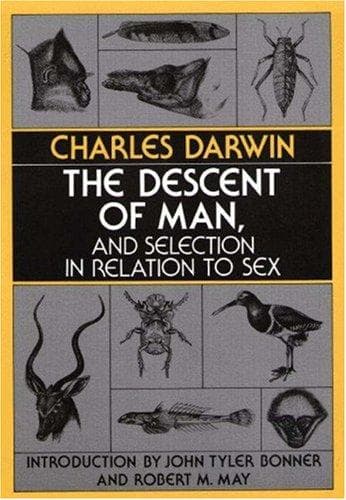
The Descent of Man, and Selection in Relation to SexDarwin, Charles
History
The Descent of Man, and Selection in Relation to Sex
Darwin, Charles
Evolution (Biology); Human beings -- Origin; Sex differences; Sexual dimorphism (Animals); Sexual selection in animals
We are, however, here concerned only with sexual selection. This
depends on the advantage which certain individuals have over others of
the same sex and species solely in respect of reproduction. When, as in
the cases above mentioned, the two sexes differ in structure in
relation to different habits of life, they have no doubt been modified
through natural selection, and by inheritance limited to one and the
same sex. So again the primary sexual organs, and those for nourishing
or protecting the young, come under the same influence; for those
individuals which generated or nourished their offspring best, would
leave, ceteris paribus, the greatest number to inherit their
superiority; whilst those which generated or nourished their offspring
badly, would leave but few to inherit their weaker powers. As the male
has to find the female, he requires organs of sense and locomotion, but
if these organs are necessary for the other purposes of life, as is
generally the case, they will have been developed through natural
selection. When the male has found the female, he sometimes absolutely
requires prehensile organs to hold her; thus Dr. Wallace informs me
that the males of certain moths cannot unite with the females if their
tarsi or feet are broken. The males of many oceanic crustaceans, when
adult, have their legs and antennae modified in an extraordinary manner
for the prehension of the female; hence we may suspect that it is
because these animals are washed about by the waves of the open sea,
that they require these organs in order to propagate their kind, and if
so, their development has been the result of ordinary or natural
selection. Some animals extremely low in the scale have been modified
for this same purpose; thus the males of certain parasitic worms, when
fully grown, have the lower surface of the terminal part of their
bodies roughened like a rasp, and with this they coil round and
permanently hold the females. (4. M. Perrier advances this case (‘Revue
Scientifique,’ Feb. 1, 1873, p. 865) as one fatal to the belief in
sexual election, inasmuch as he supposes that I attribute all the
differences between the sexes to sexual selection. This distinguished
naturalist, therefore, like so many other Frenchmen, has not taken the
trouble to understand even the first principles of sexual selection. An
English naturalist insists that the claspers of certain male animals
could not have been developed through the choice of the female! Had I
not met with this remark, I should not have thought it possible for any
one to have read this chapter and to have imagined that I maintain that
the choice of the female had anything to do with the development of the
prehensile organs in the male.)
Public-domain text, read in full here on John Shaqi.
Reviews
Reviews
No reviews yet
Be the first to share your thoughts on this work.
Elsewhere in the archive
Join the Discussion
Join the discussion
Sign in to leave a comment or review.
Sign InorCreate an account