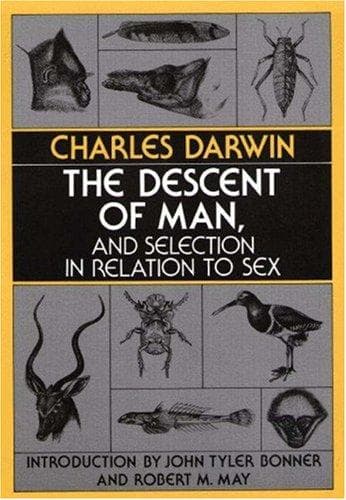
The Descent of Man, and Selection in Relation to SexDarwin, Charles
History
The Descent of Man, and Selection in Relation to Sex
Darwin, Charles
Evolution (Biology); Human beings -- Origin; Sex differences; Sexual dimorphism (Animals); Sexual selection in animals
Besides the primary and secondary sexual differences, such as the
foregoing, the males and females of some animals differ in structures
related to different habits of life, and not at all, or only
indirectly, to the reproductive functions. Thus the females of certain
flies (Culicidae and Tabanidae) are blood-suckers, whilst the males,
living on flowers, have mouths destitute of mandibles. (1. Westwood,
‘Modern Classification of Insects,’ vol. ii. 1840, p. 541. For the
statement about Tanais, mentioned below, I am indebted to Fritz
Muller.) The males of certain moths and of some crustaceans (e.g.
Tanais) have imperfect, closed mouths, and cannot feed. The
complemental males of certain Cirripedes live like epiphytic plants
either on the female or the hermaphrodite form, and are destitute of a
mouth and of prehensile limbs. In these cases it is the male which has
been modified, and has lost certain important organs, which the females
possess. In other cases it is the female which has lost such parts; for
instance, the female glow-worm is destitute of wings, as also are many
female moths, some of which never leave their cocoons. Many female
parasitic crustaceans have lost their natatory legs. In some
weevil-beetles (Curculionidae) there is a great difference between the
male and female in the length of the rostrum or snout (2. Kirby and
Spence, ‘Introduction to Entomology,’ vol. iii. 1826, p. 309.); but the
meaning of this and of many analogous differences, is not at all
understood. Differences of structure between the two sexes in relation
to different habits of life are generally confined to the lower
animals; but with some few birds the beak of the male differs from that
of the female. In the Huia of New Zealand the difference is wonderfully
great, and we hear from Dr. Buller (3. ‘Birds of New Zealand,’ 1872, p.
66.) that the male uses his strong beak in chiselling the larvae of
insects out of decayed wood, whilst the female probes the softer parts
with her far longer, much curved and pliant beak: and thus they
mutually aid each other. In most cases, differences of structure
between the sexes are more or less directly connected with the
propagation of the species: thus a female, which has to nourish a
multitude of ova, requires more food than the male, and consequently
requires special means for procuring it. A male animal, which lives for
a very short time, might lose its organs for procuring food through
disuse, without detriment; but he would retain his locomotive organs in
a perfect state, so that he might reach the female. The female, on the
other hand, might safely lose her organs for flying, swimming, or
walking, if she gradually acquired habits which rendered such powers
useless.
Public-domain text, read in full here on John Shaqi.
Reviews
Reviews
No reviews yet
Be the first to share your thoughts on this work.
Elsewhere in the archive
Join the Discussion
Join the discussion
Sign in to leave a comment or review.
Sign InorCreate an account