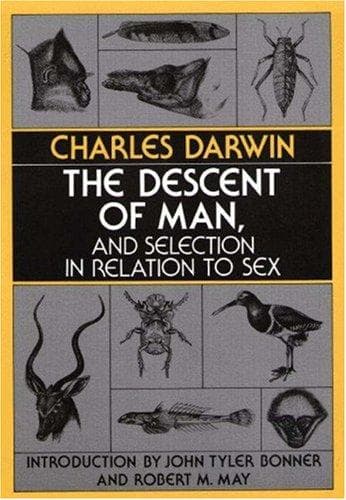
The Descent of Man, and Selection in Relation to SexDarwin, Charles
History
The Descent of Man, and Selection in Relation to Sex
Darwin, Charles
Evolution (Biology); Human beings -- Origin; Sex differences; Sexual dimorphism (Animals); Sexual selection in animals
the largest number of offspring; and these would tend to inherit
similar instincts and constitutions. It must be borne in mind that it
would have been impossible to change very materially the time of sexual
maturity in the females, without at the same time interfering with the
period of the production of the young—a period which must be determined
by the seasons of the year. On the whole there can be no doubt that
with almost all animals, in which the sexes are separate, there is a
constantly recurrent struggle between the males for the possession of
the females.
Our difficulty in regard to sexual selection lies in understanding how
it is that the males which conquer other males, or those which prove
the most attractive to the females, leave a greater number of offspring
to inherit their superiority than their beaten and less attractive
rivals. Unless this result does follow, the characters which give to
certain males an advantage over others, could not be perfected and
augmented through sexual selection. When the sexes exist in exactly
equal numbers, the worst-endowed males will (except where polygamy
prevails), ultimately find females, and leave as many offspring, as
well fitted for their general habits of life, as the best-endowed
males. From various facts and considerations, I formerly inferred that
with most animals, in which secondary sexual characters are well
developed, the males considerably exceeded the females in number; but
this is not by any means always true. If the males were to the females
as two to one, or as three to two, or even in a somewhat lower ratio,
the whole affair would be simple; for the better-armed or more
attractive males would leave the largest number of offspring. But after
investigating, as far as possible, the numerical proportion of the
sexes, I do not believe that any great inequality in number commonly
exists. In most cases sexual selection appears to have been effective
in the following manner.
Public-domain text, read in full here on John Shaqi.
Reviews
Reviews
No reviews yet
Be the first to share your thoughts on this work.
Elsewhere in the archive
Join the Discussion
Join the discussion
Sign in to leave a comment or review.
Sign InorCreate an account