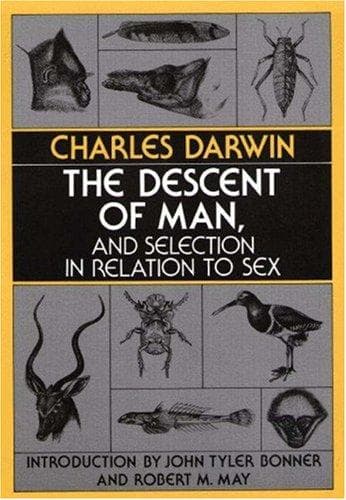
The Descent of Man, and Selection in Relation to SexDarwin, Charles
History
The Descent of Man, and Selection in Relation to Sex
Darwin, Charles
Evolution (Biology); Human beings -- Origin; Sex differences; Sexual dimorphism (Animals); Sexual selection in animals
Let us take any species, a bird for instance, and divide the females
inhabiting a district into two equal bodies, the one consisting of the
more vigorous and better-nourished individuals, and the other of the
less vigorous and healthy. The former, there can be little doubt, would
be ready to breed in the spring before the others; and this is the
opinion of Mr. Jenner Weir, who has carefully attended to the habits of
birds during many years. There can also be no doubt that the most
vigorous, best-nourished and earliest breeders would on an average
succeed in rearing the largest number of fine offspring. (7. Here is
excellent evidence on the character of the offspring from an
experienced ornithologist. Mr. J.A. Allen, in speaking (‘Mammals and
Winter Birds of E. Florida,’ p. 229) of the later broods, after the
accidental destruction of the first, says, that these “are found to be
smaller and paler-coloured than those hatched earlier in the season. In
cases where several broods are reared each year, as a general rule the
birds of the earlier broods seem in all respects the most perfect and
vigorous.”) The males, as we have seen, are generally ready to breed
before the females; the strongest, and with some species the best armed
of the males, drive away the weaker; and the former would then unite
with the more vigorous and better-nourished females, because they are
the first to breed. (8. Hermann Müller has come to this same conclusion
with respect to those female bees which are the first to emerge from
the pupa each year. See his remarkable essay, ‘Anwendung der
Darwin’schen Lehre auf Bienen,’ ‘Verh. d. V. Jahrg.’ xxix. p. 45.) Such
vigorous pairs would surely rear a larger number of offspring than the
retarded females, which would be compelled to unite with the conquered
and less powerful males, supposing the sexes to be numerically equal;
and this is all that is wanted to add, in the course of successive
generations, to the size, strength and courage of the males, or to
improve their weapons.
Public-domain text, read in full here on John Shaqi.
Reviews
Reviews
No reviews yet
Be the first to share your thoughts on this work.
Elsewhere in the archive
Join the Discussion
Join the discussion
Sign in to leave a comment or review.
Sign InorCreate an account