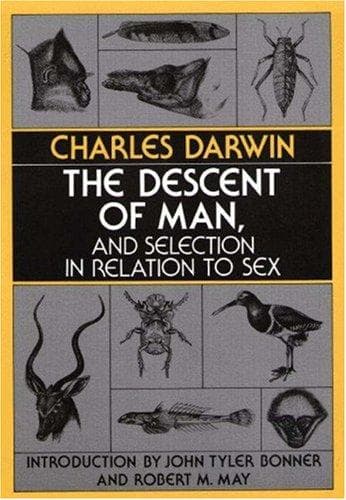
The Descent of Man, and Selection in Relation to SexDarwin, Charles
History
The Descent of Man, and Selection in Relation to Sex
Darwin, Charles
Evolution (Biology); Human beings -- Origin; Sex differences; Sexual dimorphism (Animals); Sexual selection in animals
For our present purpose we are concerned with the proportions of the
sexes, not only at birth, but also at maturity, and this adds another
element of doubt; for it is a well-ascertained fact that with man the
number of males dying before or during birth, and during the first two
years of infancy, is considerably larger than that of females. So it
almost certainly is with male lambs, and probably with some other
animals. The males of some species kill one another by fighting; or
they drive one another about until they become greatly emaciated. They
must also be often exposed to various dangers, whilst wandering about
in eager search for the females. In many kinds of fish the males are
much smaller than the females, and they are believed often to be
devoured by the latter, or by other fishes. The females of some birds
appear to die earlier than the males; they are also liable to be
destroyed on their nests, or whilst in charge of their young. With
insects the female larvae are often larger than those of the males, and
would consequently be more likely to be devoured. In some cases the
mature females are less active and less rapid in their movements than
the males, and could not escape so well from danger. Hence, with
animals in a state of nature, we must rely on mere estimation, in order
to judge of the proportions of the sexes at maturity; and this is but
little trustworthy, except when the inequality is strongly marked.
Nevertheless, as far as a judgment can be formed, we may conclude from
the facts given in the supplement, that the males of some few mammals,
of many birds, of some fish and insects, are considerably more numerous
than the females.
The proportion between the sexes fluctuates slightly during successive
years: thus with race-horses, for every 100 mares born the stallions
varied from 107.1 in one year to 92.6 in another year, and with
greyhounds from 116.3 to 95.3. But had larger numbers been tabulated
throughout an area more extensive than England, these fluctuations
would probably have disappeared; and such as they are, would hardly
suffice to lead to effective sexual selection in a state of nature.
Nevertheless, in the cases of some few wild animals, as shewn in the
supplement, the proportions seem to fluctuate either during different
seasons or in different localities in a sufficient degree to lead to
such selection. For it should be observed that any advantage, gained
during certain years or in certain localities by those males which were
able to conquer their rivals, or were the most attractive to the
females, would probably be transmitted to the offspring, and would not
subsequently be eliminated. During the succeeding seasons, when, from
the equality of the sexes, every male was able to procure a female, the
stronger or more attractive males previously produced would still have
at least as good a chance of leaving offspring as the weaker or less
attractive.
POLYGAMY.
Public-domain text, read in full here on John Shaqi.
Reviews
Reviews
No reviews yet
Be the first to share your thoughts on this work.
Elsewhere in the archive
Join the Discussion
Join the discussion
Sign in to leave a comment or review.
Sign InorCreate an account