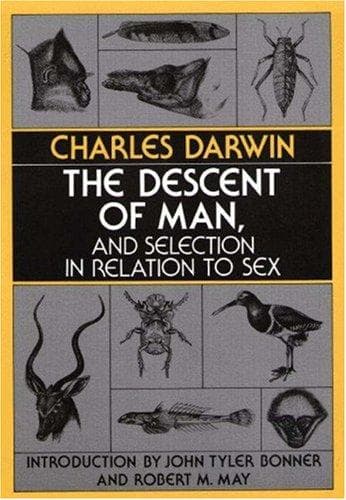
The Descent of Man, and Selection in Relation to SexDarwin, Charles
History
The Descent of Man, and Selection in Relation to Sex
Darwin, Charles
Evolution (Biology); Human beings -- Origin; Sex differences; Sexual dimorphism (Animals); Sexual selection in animals
The practice of polygamy leads to the same results as would follow from
an actual inequality in the number of the sexes; for if each male
secures two or more females, many males cannot pair; and the latter
assuredly will be the weaker or less attractive individuals. Many
mammals and some few birds are polygamous, but with animals belonging
to the lower classes I have found no evidence of this habit. The
intellectual powers of such animals are, perhaps, not sufficient to
lead them to collect and guard a harem of females. That some relation
exists between polygamy and the development of secondary sexual
characters, appears nearly certain; and this supports the view that a
numerical preponderance of males would be eminently favourable to the
action of sexual selection. Nevertheless many animals, which are
strictly monogamous, especially birds, display strongly-marked
secondary sexual characters; whilst some few animals, which are
polygamous, do not have such characters.
We will first briefly run through the mammals, and then turn to birds.
The gorilla seems to be polygamous, and the male differs considerably
from the female; so it is with some baboons, which live in herds
containing twice as many adult females as males. In South America the
Mycetes caraya presents well-marked sexual differences, in colour,
beard, and vocal organs; and the male generally lives with two or three
wives: the male of the Cebus capucinus differs somewhat from the
female, and appears to be polygamous. (10. On the Gorilla, Savage and
Wyman, ‘Boston Journal of Natural History,’ vol. v. 1845-47, p. 423. On
Cynocephalus, Brehm, ‘Thierleben,’ B. i. 1864, s. 77. On Mycetes,
Rengger, ‘Naturgeschichte der Säugethiere von Paraguay,’ 1830, ss. 14,
20. On Cebus, Brehm, ibid. s. 108.) Little is known on this head with
respect to most other monkeys, but some species are strictly
monogamous. The ruminants are eminently polygamous, and they present
sexual differences more frequently than almost any other group of
mammals; this holds good, especially in their weapons, but also in
other characters. Most deer, cattle, and sheep are polygamous; as are
most antelopes, though some are monogamous. Sir Andrew Smith, in
speaking of the antelopes of South Africa, says that in herds of about
a dozen there was rarely more than one mature male. The Asiatic
Antilope saiga appears to be the most inordinate polygamist in the
world; for Pallas (11. Pallas, ‘Spicilegia Zoolog., Fasc.’ xii. 1777,
p. 29. Sir Andrew Smith, ‘Illustrations of the Zoology of S. Africa,’
1849, pl. 29, on the Kobus. Owen, in his ‘Anatomy of Vertebrates’ (vol.
iii. 1868, p. 633) gives a table shewing incidentally which species of
antelopes are gregarious.) states that the male drives away all rivals,
and collects a herd of about a hundred females and kids together; the
female is hornless and has softer hair, but does not otherwise differ
much from the male. The wild horse of the Falkland Islands and of the
Western States of N.
Public-domain text, read in full here on John Shaqi.
Reviews
Reviews
No reviews yet
Be the first to share your thoughts on this work.
Elsewhere in the archive
Join the Discussion
Join the discussion
Sign in to leave a comment or review.
Sign InorCreate an account