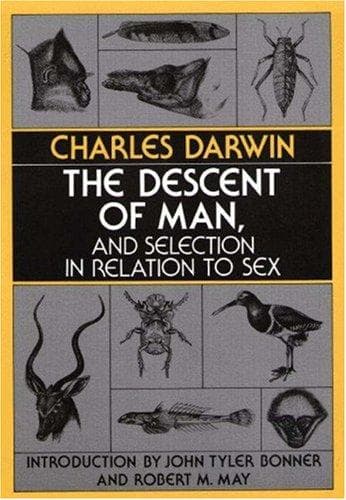
The Descent of Man, and Selection in Relation to SexDarwin, Charles
History
The Descent of Man, and Selection in Relation to Sex
Darwin, Charles
Evolution (Biology); Human beings -- Origin; Sex differences; Sexual dimorphism (Animals); Sexual selection in animals
To sum up on the means through which, as far as we can judge, sexual
selection has led to the development of secondary sexual characters. It
has been shewn that the largest number of vigorous offspring will be
reared from the pairing of the strongest and best-armed males,
victorious in contests over other males, with the most vigorous and
best-nourished females, which are the first to breed in the spring. If
such females select the more attractive, and at the same time vigorous
males, they will rear a larger number of offspring than the retarded
females, which must pair with the less vigorous and less attractive
males. So it will be if the more vigorous males select the more
attractive and at the same time healthy and vigorous females; and this
will especially hold good if the male defends the female, and aids in
providing food for the young. The advantage thus gained by the more
vigorous pairs in rearing a larger number of offspring has apparently
sufficed to render sexual selection efficient. But a large numerical
preponderance of males over females will be still more efficient;
whether the preponderance is only occasional and local, or permanent;
whether it occurs at birth, or afterwards from the greater destruction
of the females; or whether it indirectly follows from the practice of
polygamy.
THE MALE GENERALLY MORE MODIFIED THAN THE FEMALE.
Throughout the animal kingdom, when the sexes differ in external
appearance, it is, with rare exceptions, the male which has been the
more modified; for, generally, the female retains a closer resemblance
to the young of her own species, and to other adult members of the same
group. The cause of this seems to lie in the males of almost all
animals having stronger passions than the females. Hence it is the
males that fight together and sedulously display their charms before
the females; and the victors transmit their superiority to their male
offspring. Why both sexes do not thus acquire the characters of their
fathers, will be considered hereafter. That the males of all mammals
eagerly pursue the females is notorious to every one. So it is with
birds; but many cock birds do not so much pursue the hen, as display
their plumage, perform strange antics, and pour forth their song in her
presence. The male in the few fish observed seems much more eager than
the female; and the same is true of alligators, and apparently of
Batrachians. Throughout the enormous class of insects, as Kirby
remarks, “the law is that the male shall seek the female.” (18. Kirby
and Spence, ‘Introduction to Entomology,’ vol. iii. 1826, p. 342.) Two
good authorities, Mr. Blackwall and Mr. C. Spence Bate, tell me that
the males of spiders and crustaceans are more active and more erratic
in their habits than the females. When the organs of sense or
locomotion are present in the one sex of insects and crustaceans and
absent in the other, or when, as is frequently the case, they are more
Public-domain text, read in full here on John Shaqi.
Reviews
Reviews
No reviews yet
Be the first to share your thoughts on this work.
Elsewhere in the archive
Join the Discussion
Join the discussion
Sign in to leave a comment or review.
Sign InorCreate an account