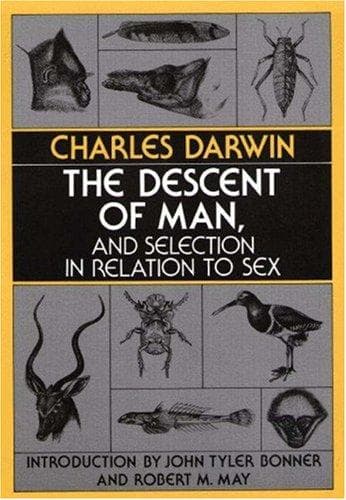
The Descent of Man, and Selection in Relation to SexDarwin, Charles
History
The Descent of Man, and Selection in Relation to Sex
Darwin, Charles
Evolution (Biology); Human beings -- Origin; Sex differences; Sexual dimorphism (Animals); Sexual selection in animals
The Gallinaceae exhibit almost as strongly marked sexual differences as
birds of paradise or humming-birds, and many of the species are, as is
well known, polygamous; others being strictly monogamous. What a
contrast is presented between the sexes of the polygamous peacock or
pheasant, and the monogamous guinea-fowl or partridge! Many similar
cases could be given, as in the grouse tribe, in which the males of the
polygamous capercailzie and black-cock differ greatly from the females;
whilst the sexes of the monogamous red grouse and ptarmigan differ very
little. In the Cursores, except amongst the bustards, few species offer
strongly-marked sexual differences, and the great bustard (Otis tarda)
is said to be polygamous. With the Grallatores, extremely few species
differ sexually, but the ruff (Machetes pugnax) affords a marked
exception, and this species is believed by Montagu to be a polygamist.
Hence it appears that amongst birds there often exists a close relation
between polygamy and the development of strongly-marked sexual
differences. I asked Mr. Bartlett, of the Zoological Gardens, who has
had very large experience with birds, whether the male tragopan (one of
the Gallinaceae) was polygamous, and I was struck by his answering, “I
do not know, but should think so from his splendid colours.”
It deserves notice that the instinct of pairing with a single female is
easily lost under domestication. The wild-duck is strictly monogamous,
the domestic-duck highly polygamous. The Rev. W.D. Fox informs me that
out of some half-tamed wild-ducks, on a large pond in his
neighbourhood, so many mallards were shot by the gamekeeper that only
one was left for every seven or eight females; yet unusually large
broods were reared. The guinea-fowl is strictly monogamous; but Mr. Fox
finds that his birds succeed best when he keeps one cock to two or
three hens. Canary-birds pair in a state of nature, but the breeders in
England successfully put one male to four or five females. I have
noticed these cases, as rendering it probable that wild monogamous
species might readily become either temporarily or permanently
polygamous.
Too little is known of the habits of reptiles and fishes to enable us
to speak of their marriage arrangements. The stickle-back
(Gasterosteus), however, is said to be a polygamist (17. Noel
Humphreys, ‘River Gardens,’ 1857.); and the male during the
breeding-season differs conspicuously from the female.
Public-domain text, read in full here on John Shaqi.
Reviews
Reviews
No reviews yet
Be the first to share your thoughts on this work.
Elsewhere in the archive
Join the Discussion
Join the discussion
Sign in to leave a comment or review.
Sign InorCreate an account