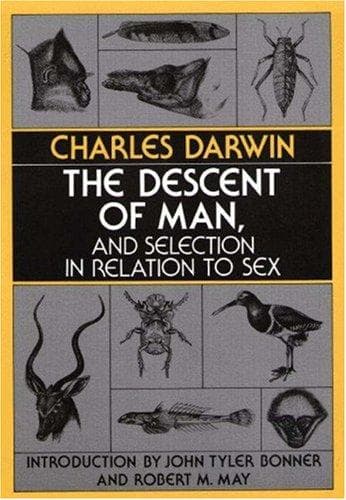
The Descent of Man, and Selection in Relation to SexDarwin, Charles
History
The Descent of Man, and Selection in Relation to Sex
Darwin, Charles
Evolution (Biology); Human beings -- Origin; Sex differences; Sexual dimorphism (Animals); Sexual selection in animals
We are naturally led to enquire why the male, in so many and such
distinct classes, has become more eager than the female, so that he
searches for her, and plays the more active part in courtship. It would
be no advantage and some loss of power if each sex searched for the
other; but why should the male almost always be the seeker? The ovules
of plants after fertilisation have to be nourished for a time; hence
the pollen is necessarily brought to the female organs—being placed on
the stigma, by means of insects or the wind, or by the spontaneous
movements of the stamens; and in the Algae, etc., by the locomotive
power of the antherozooids. With lowly-organised aquatic animals,
permanently affixed to the same spot and having their sexes separate,
the male element is invariably brought to the female; and of this we
can see the reason, for even if the ova were detached before
fertilisation, and did not require subsequent nourishment or
protection, there would yet be greater difficulty in transporting them
than the male element, because, being larger than the latter, they are
produced in far smaller numbers. So that many of the lower animals are,
in this respect, analogous with plants. (21. Prof. Sachs (‘Lehrbuch der
Botanik,’ 1870, S. 633) in speaking of the male and female reproductive
cells, remarks, “verhält sich die eine bei der Vereinigung activ,...die
andere erscheint bei der Vereinigung passiv.”) The males of affixed and
aquatic animals having been led to emit their fertilising element in
this way, it is natural that any of their descendants, which rose in
the scale and became locomotive, should retain the same habit; and they
would approach the female as closely as possible, in order not to risk
the loss of the fertilising element in a long passage of it through the
water. With some few of the lower animals, the females alone are fixed,
and the males of these must be the seekers. But it is difficult to
understand why the males of species, of which the progenitors were
primordially free, should invariably have acquired the habit of
approaching the females, instead of being approached by them. But in
all cases, in order that the males should seek efficiently, it would be
necessary that they should be endowed with strong passions; and the
acquirement of such passions would naturally follow from the more eager
leaving a larger number of offspring than the less eager.
Public-domain text, read in full here on John Shaqi.
Reviews
Reviews
No reviews yet
Be the first to share your thoughts on this work.
Elsewhere in the archive
Join the Discussion
Join the discussion
Sign in to leave a comment or review.
Sign InorCreate an account