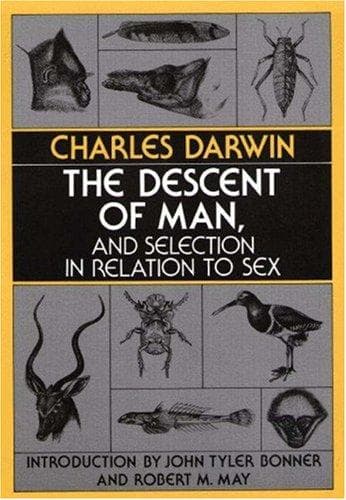
The Descent of Man, and Selection in Relation to SexDarwin, Charles
History
The Descent of Man, and Selection in Relation to Sex
Darwin, Charles
Evolution (Biology); Human beings -- Origin; Sex differences; Sexual dimorphism (Animals); Sexual selection in animals
The great eagerness of the males has thus indirectly led to their much
more frequently developing secondary sexual characters than the
females. But the development of such characters would be much aided, if
the males were more liable to vary than the females—as I concluded they
were—after a long study of domesticated animals. Von Nathusius, who has
had very wide experience, is strongly of the same opinion. (22.
‘Vorträge uber Viehzucht,’ 1872, p. 63.) Good evidence also in favour
of this conclusion can be produced by a comparison of the two sexes in
mankind. During the Novara Expedition (23. ‘Reise der Novara:
Anthropolog. Theil,’ 1867, ss. 216-269. The results were calculated by
Dr. Weisbach from measurements made by Drs. K. Scherzer and Schwarz. On
the greater variability of the males of domesticated animals, see my
‘Variation of Animals and Plants under Domestication,’ vol. ii. 1868,
p. 75.) a vast number of measurements was made of various parts of the
body in different races, and the men were found in almost every case to
present a greater range of variation than the women; but I shall have
to recur to this subject in a future chapter. Mr. J. Wood (24.
‘Proceedings of the Royal Society,’ vol. xvi. July 1868, pp. 519 and
524.), who has carefully attended to the variation of the muscles in
man, puts in italics the conclusion that “the greatest number of
abnormalities in each subject is found in the males.” He had previously
remarked that “altogether in 102 subjects, the varieties of redundancy
were found to be half as many again as in females, contrasting widely
with the greater frequency of deficiency in females before described.”
Professor Macalister likewise remarks (25. ‘Proc. Royal Irish Academy,’
vol. x. 1868, p. 123.) that variations in the muscles “are probably
more common in males than females.” Certain muscles which are not
normally present in mankind are also more frequently developed in the
male than in the female sex, although exceptions to this rule are said
to occur. Dr. Burt Wilder (26. ‘Massachusetts Medical Society,’ vol.
ii. No. 3, 1868, p. 9.) has tabulated the cases of 152 individuals with
supernumerary digits, of which 86 were males, and 39, or less than
half, females, the remaining 27 being of unknown sex. It should not,
however, be overlooked that women would more frequently endeavour to
conceal a deformity of this kind than men. Again, Dr. L. Meyer asserts
that the ears of man are more variable in form than those of a woman.
(27. ‘Archiv fur Path. Anat. und Phys.’ 1871, p. 488.) Lastly the
temperature is more variable in man than in woman. (28. The conclusions
recently arrived at by Dr. J. Stockton Hough, on the temperature of
man, are given in the ‘Pop. Sci. Review,’ Jan. 1st, 1874, p. 97.)
Public-domain text, read in full here on John Shaqi.
Reviews
Reviews
No reviews yet
Be the first to share your thoughts on this work.
Elsewhere in the archive
Join the Discussion
Join the discussion
Sign in to leave a comment or review.
Sign InorCreate an account