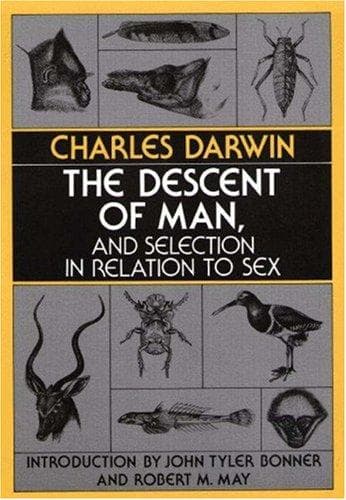
The Descent of Man, and Selection in Relation to SexDarwin, Charles
History
The Descent of Man, and Selection in Relation to Sex
Darwin, Charles
Evolution (Biology); Human beings -- Origin; Sex differences; Sexual dimorphism (Animals); Sexual selection in animals
It may be suggested that in some cases a double process of selection
has been carried on; that the males have selected the more attractive
females, and the latter the more attractive males. This process,
however, though it might lead to the modification of both sexes, would
not make the one sex different from the other, unless indeed their
tastes for the beautiful differed; but this is a supposition too
improbable to be worth considering in the case of any animal, excepting
man. There are, however, many animals in which the sexes resemble each
other, both being furnished with the same ornaments, which analogy
would lead us to attribute to the agency of sexual selection. In such
cases it may be suggested with more plausibility, that there has been a
double or mutual process of sexual selection; the more vigorous and
precocious females selecting the more attractive and vigorous males,
the latter rejecting all except the more attractive females. But from
what we know of the habits of animals, this view is hardly probable,
for the male is generally eager to pair with any female. It is more
probable that the ornaments common to both sexes were acquired by one
sex, generally the male, and then transmitted to the offspring of both
sexes. If, indeed, during a lengthened period the males of any species
were greatly to exceed the females in number, and then during another
lengthened period, but under different conditions, the reverse were to
occur, a double, but not simultaneous, process of sexual selection
might easily be carried on, by which the two sexes might be rendered
widely different.
We shall hereafter see that many animals exist, of which neither sex is
brilliantly coloured or provided with special ornaments, and yet the
members of both sexes or of one alone have probably acquired simple
colours, such as white or black, through sexual selection. The absence
of bright tints or other ornaments may be the result of variations of
the right kind never having occurred, or of the animals themselves
having preferred plain black or white. Obscure tints have often been
developed through natural selection for the sake of protection, and the
acquirement through sexual selection of conspicuous colours, appears to
have been sometimes checked from the danger thus incurred. But in other
cases the males during long ages may have struggled together for the
possession of the females, and yet no effect will have been produced,
unless a larger number of offspring were left by the more successful
males to inherit their superiority, than by the less successful: and
this, as previously shewn, depends on many complex contingencies.
Public-domain text, read in full here on John Shaqi.
Reviews
Reviews
No reviews yet
Be the first to share your thoughts on this work.
Elsewhere in the archive
Join the Discussion
Join the discussion
Sign in to leave a comment or review.
Sign InorCreate an account