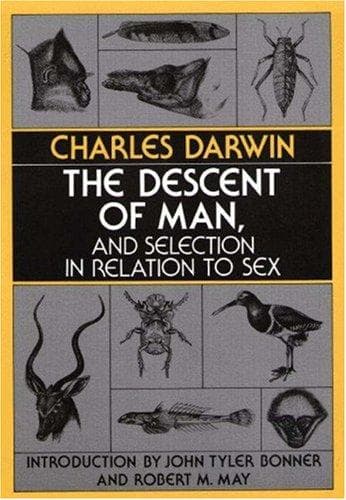
The Descent of Man, and Selection in Relation to SexDarwin, Charles
History
The Descent of Man, and Selection in Relation to Sex
Darwin, Charles
Evolution (Biology); Human beings -- Origin; Sex differences; Sexual dimorphism (Animals); Sexual selection in animals
From the causes just specified the two sexes can hardly fail to differ
somewhat in constitution, at least during the breeding-season; and,
although they may be subjected to exactly the same conditions, they
will tend to vary in a different manner. If such variations are of no
service to either sex, they will not be accumulated and increased by
sexual or natural selection. Nevertheless, they may become permanent if
the exciting cause acts permanently; and in accordance with a frequent
form of inheritance they may be transmitted to that sex alone in which
they first appeared. In this case the two sexes will come to present
permanent, yet unimportant, differences of character. For instance, Mr.
Allen shews that with a large number of birds inhabiting the northern
and southern United States, the specimens from the south are
darker-coloured than those from the north; and this seems to be the
direct result of the difference in temperature, light, etc., between
the two regions. Now, in some few cases, the two sexes of the same
species appear to have been differently affected; in the Agelaeus
phoeniceus the males have had their colours greatly intensified in the
south; whereas with Cardinalis virginianus it is the females which have
been thus affected; with Quiscalus major the females have been rendered
extremely variable in tint, whilst the males remain nearly uniform.
(31. ‘Mammals and Birds of E. Florida,’ pp. 234, 280, 295.)
A few exceptional cases occur in various classes of animals, in which
the females instead of the males have acquired well pronounced
secondary sexual characters, such as brighter colours, greater size,
strength, or pugnacity. With birds there has sometimes been a complete
transposition of the ordinary characters proper to each sex; the
females having become the more eager in courtship, the males remaining
comparatively passive, but apparently selecting the more attractive
females, as we may infer from the results. Certain hen birds have thus
been rendered more highly coloured or otherwise ornamented, as well as
more powerful and pugnacious than the cocks; these characters being
transmitted to the female offspring alone.
Public-domain text, read in full here on John Shaqi.
Reviews
Reviews
No reviews yet
Be the first to share your thoughts on this work.
Elsewhere in the archive
Join the Discussion
Join the discussion
Sign in to leave a comment or review.
Sign InorCreate an account