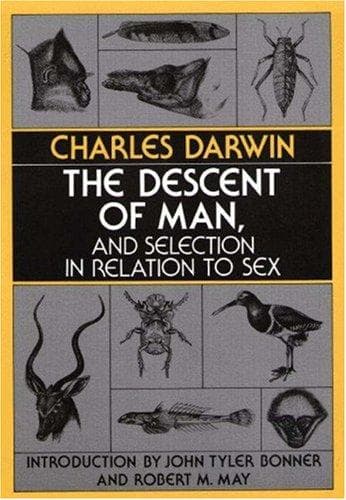
The Descent of Man, and Selection in Relation to SexDarwin, Charles
History
The Descent of Man, and Selection in Relation to Sex
Darwin, Charles
Evolution (Biology); Human beings -- Origin; Sex differences; Sexual dimorphism (Animals); Sexual selection in animals
In order to understand how sexual selection has acted on many animals
of many classes, and in the course of ages has produced a conspicuous
result, it is necessary to bear in mind the laws of inheritance, as far
as they are known. Two distinct elements are included under the term
“inheritance”—the transmission, and the development of characters; but
as these generally go together, the distinction is often overlooked. We
see this distinction in those characters which are transmitted through
the early years of life, but are developed only at maturity or during
old age. We see the same distinction more clearly with secondary sexual
characters, for these are transmitted through both sexes, though
developed in one alone. That they are present in both sexes, is
manifest when two species, having strongly-marked sexual characters,
are crossed, for each transmits the characters proper to its own male
and female sex to the hybrid offspring of either sex. The same fact is
likewise manifest, when characters proper to the male are occasionally
developed in the female when she grows old or becomes diseased, as, for
instance, when the common hen assumes the flowing tail-feathers,
hackles, comb, spurs, voice, and even pugnacity of the cock.
Conversely, the same thing is evident, more or less plainly, with
castrated males. Again, independently of old age or disease, characters
are occasionally transferred from the male to the female, as when, in
certain breeds of the fowl, spurs regularly appear in the young and
healthy females. But in truth they are simply developed in the female;
for in every breed each detail in the structure of the spur is
transmitted through the female to her male offspring. Many cases will
hereafter be given, where the female exhibits, more or less perfectly,
characters proper to the male, in whom they must have been first
developed, and then transferred to the female. The converse case of the
first development of characters in the female and of transference to
the male, is less frequent; it will therefore be well to give one
striking instance. With bees the pollen-collecting apparatus is used by
the female alone for gathering pollen for the larvae, yet in most of
the species it is partially developed in the males to whom it is quite
useless, and it is perfectly developed in the males of Bombus or the
humble-bee. (32. H. Muller, ‘Anwendung der Darwin’schen Lehre,’ etc.,
Verh. d. n. V. Jahrg., xxix. p. 42.) As not a single other
Hymenopterous insect, not even the wasp, which is closely allied to the
bee, is provided with a pollen-collecting apparatus, we have no grounds
for supposing that male bees primordially collected pollen as well as
the females; although we have some reason to suspect that male mammals
primordially suckled their young as well as the females. Lastly, in all
cases of reversion, characters are transmitted through two, three, or
many more generations, and are then developed under certain unknown
favourable conditions.
Public-domain text, read in full here on John Shaqi.
Reviews
Reviews
No reviews yet
Be the first to share your thoughts on this work.
Elsewhere in the archive
Join the Discussion
Join the discussion
Sign in to leave a comment or review.
Sign InorCreate an account