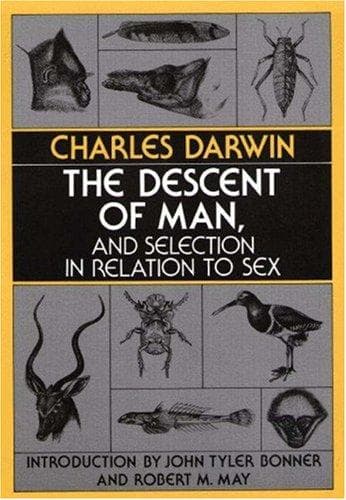
The Descent of Man, and Selection in Relation to SexDarwin, Charles
History
The Descent of Man, and Selection in Relation to Sex
Darwin, Charles
Evolution (Biology); Human beings -- Origin; Sex differences; Sexual dimorphism (Animals); Sexual selection in animals
This important distinction between transmission
and development will be best kept in mind by the aid of the hypothesis
of pangenesis. According to this hypothesis, every unit or cell of the
body throws off gemmules or undeveloped atoms, which are transmitted to
the offspring of both sexes, and are multiplied by self-division. They
may remain undeveloped during the early years of life or during
successive generations; and their development into units or cells, like
those from which they were derived, depends on their affinity for, and
union with other units or cells previously developed in the due order
of growth.
INHERITANCE AT CORRESPONDING PERIODS OF LIFE.
This tendency is well established. A new character, appearing in a
young animal, whether it lasts throughout life or is only transient,
will, in general, reappear in the offspring at the same age and last
for the same time. If, on the other hand, a new character appears at
maturity, or even during old age, it tends to reappear in the offspring
at the same advanced age. When deviations from this rule occur, the
transmitted characters much oftener appear before, than after the
corresponding age. As I have dwelt on this subject sufficiently in
another work (33. The ‘Variation of Animals and Plants under
Domestication,’ vol. ii. 1868, p. 75. In the last chapter but one, the
provisional hypothesis of pangenesis, above alluded to, is fully
explained.), I will here merely give two or three instances, for the
sake of recalling the subject to the reader’s mind. In several breeds
of the Fowl, the down-covered chickens, the young birds in their first
true plumage, and the adults differ greatly from one another, as well
as from their common parent-form, the Gallus bankiva; and these
characters are faithfully transmitted by each breed to their offspring
at the corresponding periods of life. For instance, the chickens of
spangled Hamburgs, whilst covered with down, have a few dark spots on
the head and rump, but are not striped longitudinally, as in many other
breeds; in their first true plumage, “they are beautifully pencilled,”
that is each feather is transversely marked by numerous dark bars; but
in their second plumage the feathers all become spangled or tipped with
a dark round spot. (34. These facts are given on the high authority of
a great breeder, Mr. Teebay; see Tegetmeier’s ‘Poultry Book,’ 1868, p.
158. On the characters of chickens of different breeds, and on the
breeds of the pigeon, alluded to in the following paragraph, see
‘Variation of Animals,’ etc., vol. i. pp. 160, 249; vol. ii. p. 77.)
Hence in this breed variations have occurred at, and been transmitted
to, three distinct periods of life. The Pigeon offers a more remarkable
case, because the aboriginal parent species does not undergo any change
of plumage with advancing age, excepting that at maturity the breast
becomes more iridescent; yet there are breeds which do not acquire
Public-domain text, read in full here on John Shaqi.
Reviews
Reviews
No reviews yet
Be the first to share your thoughts on this work.
Elsewhere in the archive
Join the Discussion
Join the discussion
Sign in to leave a comment or review.
Sign InorCreate an account