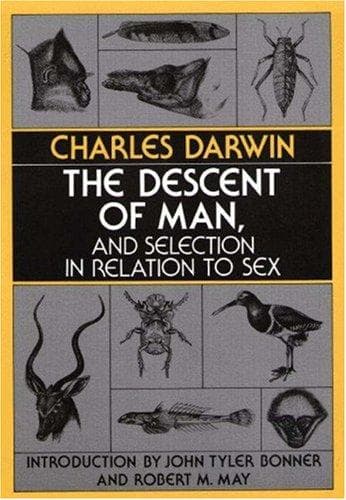
The Descent of Man, and Selection in Relation to SexDarwin, Charles
History
The Descent of Man, and Selection in Relation to Sex
Darwin, Charles
Evolution (Biology); Human beings -- Origin; Sex differences; Sexual dimorphism (Animals); Sexual selection in animals
their characteristic colours until they have moulted two, three, or
four times; and these modifications of plumage are regularly
transmitted.
INHERITANCE AT CORRESPONDING SEASONS OF THE YEAR.
With animals in a state of nature, innumerable instances occur of
characters appearing periodically at different seasons. We see this in
the horns of the stag, and in the fur of Arctic animals which becomes
thick and white during the winter. Many birds acquire bright colours
and other decorations during the breeding-season alone. Pallas states
(35. ‘Novae species Quadrupedum e Glirium ordine,’ 1778, p. 7. On the
transmission of colour by the horse, see ‘Variation of Animals and
Plants under Domestication,’ vol. i. p. 51. Also vol. ii. p. 71, for a
general discussion on ‘Inheritance as limited by Sex.’), that in
Siberia domestic cattle and horses become lighter-coloured during the
winter; and I have myself observed, and heard of similar strongly
marked changes of colour, that is, from brownish cream-colour or
reddish-brown to a perfect white, in several ponies in England.
Although I do not know that this tendency to change the colour of the
coat during different seasons is transmitted, yet it probably is so, as
all shades of colour are strongly inherited by the horse. Nor is this
form of inheritance, as limited by the seasons, more remarkable than
its limitation by age or sex.
INHERITANCE AS LIMITED BY SEX. — The equal transmission of characters
to both sexes is the commonest form of inheritance, at least with those
animals which do not present strongly-marked sexual differences, and
indeed with many of these. But characters are somewhat commonly
transferred exclusively to that sex, in which they first appear. Ample
evidence on this head has been advanced in my work on ‘Variation under
Domestication,’ but a few instances may here be given. There are breeds
of the sheep and goat, in which the horns of the male differ greatly in
shape from those of the female; and these differences, acquired under
domestication, are regularly transmitted to the same sex. As a rule, it
is the females alone in cats which are tortoise-shell, the
corresponding colour in the males being rusty-red. With most breeds of
the fowl, the characters proper to each sex are transmitted to the same
sex alone. So general is this form of transmission that it is an
anomaly when variations in certain breeds are transmitted equally to
both sexes. There are also certain sub-breeds of the fowl in which the
males can hardly be distinguished from one another, whilst the females
differ considerably in colour. The sexes of the pigeon in the
parent-species do not differ in any external character; nevertheless,
in certain domesticated breeds the male is coloured differently from
the female. (36. Dr. Chapuis, ‘Le Pigeon Voyageur Belge,’ 1865, p. 87.
Boitard et Corbie, ‘Les Pigeons de Volière,’ etc., 1824, p. 173. See,
also, on similar differences in certain breeds at Modena, ‘Le
Public-domain text, read in full here on John Shaqi.
Reviews
Reviews
No reviews yet
Be the first to share your thoughts on this work.
Elsewhere in the archive
Join the Discussion
Join the discussion
Sign in to leave a comment or review.
Sign InorCreate an account