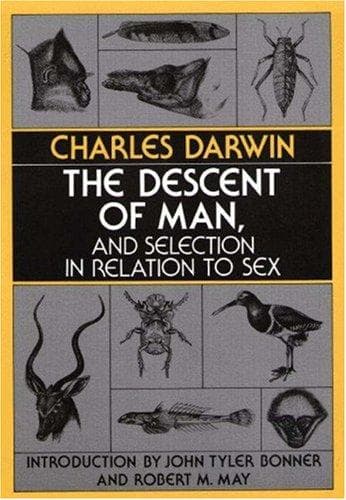
The Descent of Man, and Selection in Relation to SexDarwin, Charles
History
The Descent of Man, and Selection in Relation to Sex
Darwin, Charles
Evolution (Biology); Human beings -- Origin; Sex differences; Sexual dimorphism (Animals); Sexual selection in animals
Why certain characters should be inherited by both sexes, and other
characters by one sex alone, namely by that sex in which the character
first appeared, is in most cases quite unknown. We cannot even
conjecture why with certain sub-breeds of the pigeon, black striae,
though transmitted through the female, should be developed in the male
alone, whilst every other character is equally transferred to both
sexes. Why, again, with cats, the tortoise-shell colour should, with
rare exceptions, be developed in the female alone. The very same
character, such as deficient or supernumerary digits, colour-blindness,
etc., may with mankind be inherited by the males alone of one family,
and in another family by the females alone, though in both cases
transmitted through the opposite as well as through the same sex. (38.
References are given in my ‘Variation of Animals and Plants under
Domestication,’ vol. ii. p. 72.) Although we are thus ignorant, the two
following rules seem often to hold good—that variations which first
appear in either sex at a late period of life, tend to be developed in
the same sex alone; whilst variations which first appear early in life
in either sex tend to be developed in both sexes. I am, however, far
from supposing that this is the sole determining cause. As I have not
elsewhere discussed this subject, and it has an important bearing on
sexual selection, I must here enter into lengthy and somewhat intricate
details.
It is in itself probable that any character appearing at an early age
would tend to be inherited equally by both sexes, for the sexes do not
differ much in constitution before the power of reproduction is gained.
On the other hand, after this power has been gained and the sexes have
come to differ in constitution, the gemmules (if I may again use the
language of pangenesis) which are cast off from each varying part in
the one sex would be much more likely to possess the proper affinities
for uniting with the tissues of the same sex, and thus becoming
developed, than with those of the opposite sex.
Public-domain text, read in full here on John Shaqi.
Reviews
Reviews
No reviews yet
Be the first to share your thoughts on this work.
Elsewhere in the archive
Join the Discussion
Join the discussion
Sign in to leave a comment or review.
Sign InorCreate an account