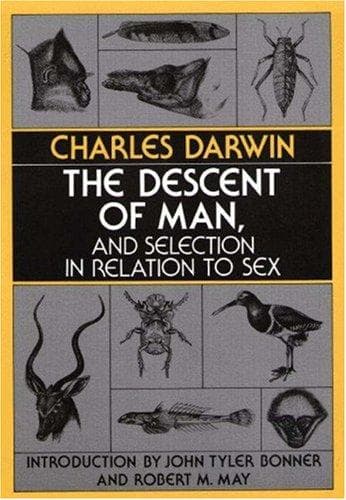
The Descent of Man, and Selection in Relation to SexDarwin, Charles
History
The Descent of Man, and Selection in Relation to Sex
Darwin, Charles
Evolution (Biology); Human beings -- Origin; Sex differences; Sexual dimorphism (Animals); Sexual selection in animals
I was first led to infer that a relation of this kind exists, from the
fact that whenever and in whatever manner the adult male differs from
the adult female, he differs in the same manner from the young of both
sexes. The generality of this fact is quite remarkable: it holds good
with almost all mammals, birds, amphibians, and fishes; also with many
crustaceans, spiders, and some few insects, such as certain orthoptera
and libellulae. In all these cases the variations, through the
accumulation of which the male acquired his proper masculine
characters, must have occurred at a somewhat late period of life;
otherwise the young males would have been similarly characterised; and
conformably with our rule, the variations are transmitted to and
developed in the adult males alone. When, on the other hand, the adult
male closely resembles the young of both sexes (these, with rare
exceptions, being alike), he generally resembles the adult female; and
in most of these cases the variations through which the young and old
acquired their present characters, probably occurred, according to our
rule, during youth. But there is here room for doubt, for characters
are sometimes transferred to the offspring at an earlier age than that
at which they first appeared in the parents, so that the parents may
have varied when adult, and have transferred their characters to their
offspring whilst young. There are, moreover, many animals, in which the
two sexes closely resemble each other, and yet both differ from their
young: and here the characters of the adults must have been acquired
late in life; nevertheless, these characters, in apparent contradiction
to our rule, are transferred to both sexes. We must not however,
overlook the possibility or even probability of successive variations
of the same nature occurring, under exposure to similar conditions,
simultaneously in both sexes at a rather late period of life; and in
this case the variations would be transferred to the offspring of both
sexes at a corresponding late age; and there would then be no real
contradiction to the rule that variations occurring late in life are
transferred exclusively to the sex in which they first appeared. This
latter rule seems to hold true more generally than the second one,
namely, that variations which occur in either sex early in life tend to
be transferred to both sexes. As it was obviously impossible even to
estimate in how large a number of cases throughout the animal kingdom
these two propositions held good, it occurred to me to investigate some
striking or crucial instances, and to rely on the result.
Public-domain text, read in full here on John Shaqi.
Reviews
Reviews
No reviews yet
Be the first to share your thoughts on this work.
Elsewhere in the archive
Join the Discussion
Join the discussion
Sign in to leave a comment or review.
Sign InorCreate an account