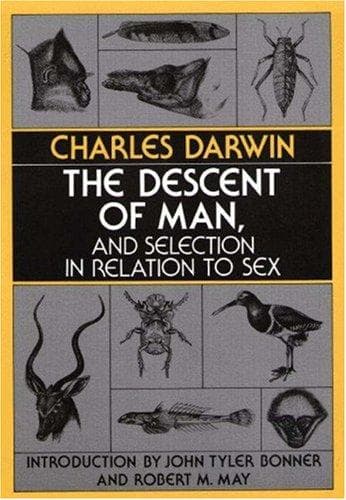
The Descent of Man, and Selection in Relation to SexDarwin, Charles
History
The Descent of Man, and Selection in Relation to Sex
Darwin, Charles
Evolution (Biology); Human beings -- Origin; Sex differences; Sexual dimorphism (Animals); Sexual selection in animals
breed than in ordinary sheep in which both sexes are horned. But with
domesticated sheep the presence or absence of horns is not a firmly
fixed character; for a certain proportion of the merino ewes bear small
horns, and some of the rams are hornless; and in most breeds hornless
ewes are occasionally produced.
Dr. W. Marshall has lately made a special study of the protuberances so
common on the heads of birds (43. ‘Über die knochernen Schädelhöcker
der Vögel,’ in the ‘Niederland. Archiv fur Zoologie,’ B.i. Heft 2,
1872.), and he comes to the following conclusion:—that with those
species in which they are confined to the males, they are developed
late in life; whereas with those species in which they are common to
the two sexes, they are developed at a very early period. This is
certainly a striking confirmation of my two laws of inheritance.
In most of the species of the splendid family of the Pheasants, the
males differ conspicuously from the females, and they acquire their
ornaments at a rather late period of life. The eared pheasant
(Crossoptilon auritum), however, offers a remarkable exception, for
both sexes possess the fine caudal plumes, the large ear-tufts and the
crimson velvet about the head; I find that all these characters appear
very early in life in accordance with rule. The adult male can,
however, be distinguished from the adult female by the presence of
spurs; and conformably with our rule, these do not begin to be
developed before the age of six months, as I am assured by Mr.
Bartlett, and even at this age, the two sexes can hardly be
distinguished. (44. In the common peacock (Pavo cristatus) the male
alone possesses spurs, whilst both sexes of the Java Peacock (P.
muticus) offer the unusual case of being furnished with spurs. Hence I
fully expected that in the latter species they would have been
developed earlier in life than in the common peacock; but M. Hegt of
Amsterdam informs me, that with young birds of the previous year, of
both species, compared on April 23rd, 1869, there was no difference in
the development of the spurs. The spurs, however, were as yet
represented merely by slight knobs or elevations. I presume that I
should have been informed if any difference in the rate of development
had been observed subsequently.) The male and female Peacock differ
conspicuously from each other in almost every part of their plumage,
except in the elegant head-crest, which is common to both sexes; and
this is developed very early in life, long before the other ornaments,
which are confined to the male. The wild-duck offers an analogous case,
for the beautiful green speculum on the wings is common to both sexes,
though duller and somewhat smaller in the female, and it is developed
early in life, whilst the curled tail-feathers and other ornaments of
the male are developed later. (45. In some other species of the Duck
family the speculum differs in a greater degree in the two sexes; but I
Public-domain text, read in full here on John Shaqi.
Reviews
Reviews
No reviews yet
Be the first to share your thoughts on this work.
Elsewhere in the archive
Join the Discussion
Join the discussion
Sign in to leave a comment or review.
Sign InorCreate an account