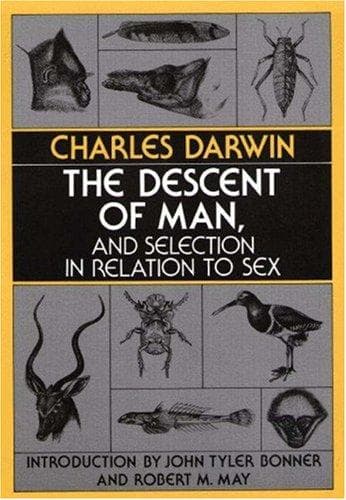
The Descent of Man, and Selection in Relation to SexDarwin, Charles
History
The Descent of Man, and Selection in Relation to Sex
Darwin, Charles
Evolution (Biology); Human beings -- Origin; Sex differences; Sexual dimorphism (Animals); Sexual selection in animals
In several kinds of antelopes, only the males are provided with horns,
whilst in the greater number both sexes bear horns. With respect to the
period of development, Mr. Blyth informs me that there was at one time
in the Zoological Gardens a young koodoo (Ant. strepsiceros), of which
the males alone are horned, and also the young of a closely-allied
species, the eland (Ant. oreas), in which both sexes are horned. Now it
is in strict conformity with our rule, that in the young male koodoo,
although ten months old, the horns were remarkably small, considering
the size ultimately attained by them; whilst in the young male eland,
although only three months old, the horns were already very much larger
than in the koodoo. It is also a noticeable fact that in the
prong-horned antelope (40. Antilocapra Americana. I have to thank Dr.
Canfield for information with respect to the horns of the female: see
also his paper in ‘Proceedings of the Zoological Society,’ 1866, p.
109. Also Owen, ‘Anatomy of Vertebrates,’ vol. iii. p. 627), only a few
of the females, about one in five, have horns, and these are in a
rudimentary state, though sometimes above four inches long: so that as
far as concerns the possession of horns by the males alone, this
species is in an intermediate condition, and the horns do not appear
until about five or six months after birth. Therefore in comparison
with what little we know of the development of the horns in other
antelopes, and from what we do know with respect to the horns of deer,
cattle, etc., those of the prong-horned antelope appear at an
intermediate period of life,—that is, not very early, as in cattle and
sheep, nor very late, as in the larger deer and antelopes. The horns of
sheep, goats, and cattle, which are well developed in both sexes,
though not quite equal in size, can be felt, or even seen, at birth or
soon afterwards. (41. I have been assured that the horns of the sheep
in North Wales can always be felt, and are sometimes even an inch in
length, at birth. Youatt says (‘Cattle,’ 1834, p. 277), that the
prominence of the frontal bone in cattle penetrates the cutis at birth,
and that the horny matter is soon formed over it.) Our rule, however,
seems to fail in some breeds of sheep, for instance merinos, in which
the rams alone are horned; for I cannot find on enquiry (42. I am
greatly indebted to Prof. Victor Carus for having made enquiries for
me, from the highest authorities, with respect to the merino sheep of
Saxony. On the Guinea coast of Africa there is, however, a breed of
sheep in which, as with merinos, the rams alone bear horns; and Mr.
Winwood Reade informs me that in one case observed by him, a young ram,
born on Feb. 10th, first shewed horns on March 6th, so that in this
instance, in conformity with rule, the development of the horns
occurred at a later period of life than in Welsh sheep, in which both
sexes are horned.), that the horns are developed later in life in this
Public-domain text, read in full here on John Shaqi.
Reviews
Reviews
No reviews yet
Be the first to share your thoughts on this work.
Elsewhere in the archive
Join the Discussion
Join the discussion
Sign in to leave a comment or review.
Sign InorCreate an account