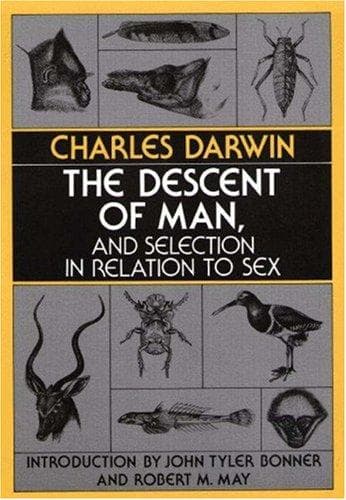
The Descent of Man, and Selection in Relation to SexDarwin, Charles
History
The Descent of Man, and Selection in Relation to Sex
Darwin, Charles
Evolution (Biology); Human beings -- Origin; Sex differences; Sexual dimorphism (Animals); Sexual selection in animals
We have as yet considered the transference of characters, relatively to
their period of development, only in species in a natural state; we
will now turn to domesticated animals, and first touch on monstrosities
and diseases. The presence of supernumerary digits, and the absence of
certain phalanges, must be determined at an early embryonic period—the
tendency to profuse bleeding is at least congenital, as is probably
colour-blindness—yet these peculiarities, and other similar ones, are
often limited in their transmission to one sex; so that the rule that
characters, developed at an early period, tend to be transmitted to
both sexes, here wholly fails. But this rule, as before remarked, does
not appear to be nearly so general as the converse one, namely, that
characters which appear late in life in one sex are transmitted
exclusively to the same sex. From the fact of the above abnormal
peculiarities becoming attached to one sex, long before the sexual
functions are active, we may infer that there must be some difference
between the sexes at an extremely early age. With respect to
sexually-limited diseases, we know too little of the period at which
they originate, to draw any safe conclusion. Gout, however, seems to
fall under our rule, for it is generally caused by intemperance during
manhood, and is transmitted from the father to his sons in a much more
marked manner than to his daughters.
In the various domestic breeds of sheep, goats, and cattle, the males
differ from their respective females in the shape or development of
their horns, forehead, mane, dewlap, tail, and hump on the shoulders;
and these peculiarities, in accordance with our rule, are not fully
developed until a rather late period of life. The sexes of dogs do not
differ, except that in certain breeds, especially in the Scotch
deer-hound, the male is much larger and heavier than the female; and,
as we shall see in a future chapter, the male goes on increasing in
size to an unusually late period of life, which, according to rule,
will account for his increased size being transmitted to his male
offspring alone. On the other hand, the tortoise-shell colour, which is
confined to female cats, is quite distinct at birth, and this case
violates the rule. There is a breed of pigeons in which the males alone
are streaked with black, and the streaks can be detected even in the
nestlings; but they become more conspicuous at each successive moult,
so that this case partly opposes and partly supports the rule. With the
English Carrier and Pouter pigeons, the full development of the wattle
and the crop occurs rather late in life, and conformably with the rule,
these characters are transmitted in full perfection to the males alone.
The following cases perhaps come within the class previously alluded
to, in which both sexes have varied in the same manner at a rather late
period of life, and have consequently transferred their new characters
Public-domain text, read in full here on John Shaqi.
Reviews
Reviews
No reviews yet
Be the first to share your thoughts on this work.
Elsewhere in the archive
Join the Discussion
Join the discussion
Sign in to leave a comment or review.
Sign InorCreate an account